Saturday, September 11, 2010

Endless Blue - Week 37.4 - The Kelpygmies: Primatives of the Kelp Forests

Botany

The Kelpygmies-- Primitives of the Kelp Forests

Much has been made of the civilized races, and even those relegated to the primitive races have made their mark on the cultures of the Known World.  But there a tiny few other races -- more primordial and archaic that the primitives races -- that have begun to influence life in the ocean of Elqua.

Kelpygmy

Small Plant
Hit Dice: 1d8 (4 hp)
Initiative: +2
Speed: 30 ft. (6 cubes)
Armor Class: 16 (+1 size, +2 Dex, +3 natural), touch 13, flat-footed 14
Base Attack/Grapple: +0/-4
Attack: Claw +1 melee (1d4) or longspear +1 melee (1d6, crit x3)
Full Attack: 2 claws +1 melee (1d4) or longspear +1 melee (1d6, crit x3)
Space/Reach: 5 ft./5 ft. (10 ft. with longspear)
Special Attacks: —
Special Qualities: Damage reduction 5/piercing, immunity to bludgeoning, immunity to electricity, low-light vision, plant traits, ultravision
Saves: Fort +2, Ref +2, Will +0
Abilities: Str 11, Dex 14, Con 11, Int 6, Wis 10, Cha 10
Skills: Hide +11, Listen +3, Move Silently +7, Spot +3
Feats: Alertness, Hide in Plain Sight, Trackless Scent
Environment: Kelp Forests of the Shore and Shoals
Organization: Gang (2-5) or attack party (4-7 + 1 shaman, and possibly 1 shambling mound)
Challenge Rating: 1/2
Treasure: Standard
Alignment: Always neutral
Advancement: By character class (see below).
Level Adjustment: —

Kelpygmy morphology follows the piscean form in miniature, with lengths of only 2 and a half to four feet long.  They possess a torso with two arms and two pelvic fins, which then tappers down from the hips into a tail like a fish.  Their skin has a strange, olive-colored, waxy rind-like texture, as if they were vegetables molded into piscean form, and sport circles of leafy tendrils ringed around their waist, wrists, and tail flukes.  A tuft of this same brownish seaweed is tied in a topknot at the apex above their heads, which house a pair of glossy green eyes and a wide mouth filled with blocky, clumsily arranged teeth.  Their four fingered hands are tipped with small yet sturdy thorns that act as claws that are quite adept at rending kelp nautiluses apart.  Examination of kelpymy bodies reveal they have no ears, yet in-the-field evidence points strongly to the fact they can most certainly hear with acuity.  They also have the gill slits that pisceans do, but lack the internal skeletal and organ systems to support they function.


Kelpygmies are a recent occurrence, having sprung up suddenly in the last few years.  Almost nothing is known for sure about them other than they are cunning, dangerous, and hate piscean life.  They are not carnivores, and do not attack pisceans for food.  Attempts at finding kelpygmy settlements have failed utterly, usually ending in either the searching party being slain to the last piscean, or with the pursued plant-things disappearing before their eyes.  It is concluded that the race has not developed shelter yet, and blindly wander the currents, living off the land like migratory animals.

The habitat of the kelpygmy is estimated to range from the Tropic of Kraken through to the Tropic of Cetacean.  Environments further north or south seem to be too cold for the liking of the pygmies.
Kelpygmies do not posses a complex language.  What passes for their native tongue, called Pygmit,  is a handful of iconic words with little in the way of conjugation.  Ideas require repetition, and frequently punctuated wit  thumps to their chest or striking their spears on coral, stone, or other hard surface.  If not for the species intrinsic hatred for piscean life, study of their burgeoning language would provide incredible insight into the origin of speech in other cultures.

As an illiterate culture, kelpygmies may only gain levels in barbarian, druid, or packbreeder.  Packbreeder pygmies learn the secret of bending shambling mounds to their will, while those that follow the druid path become shaman.  The bulk of kelpygmies become barbarians, with the most advance warrior becoming the group's chieftan.

Combat

The kelpygmy have begun a campiagn of border incurssions on rural farmlands, slaying all pisceans in the area and leaving their corpses unweighted to rise to the Vastness.  This aggressively territorial behavior has made the species extremely difficult to deal with, and as a result most treat the kelpygmies as immediate threats to safety.  Luckily the backwards species is not organized enough to pose a significant threat to the security the major nations.


Attacking kelpygmies utilize either their thorny claws or simplistic weapons, usually a longspear in the form of a sharpened stick.  Favoring ambush strategies that rival the guerrilla tactics of the Ceph ambushers, they escape detection by using their natural coloration to blend with the kelp-choked surroundings.  Often times they will use the wildlife around them to their benefit, either luring the victim towards a predator, or vice versa.


Damage Resistance to Piercing Weapons (Ex): The thick rind that comprises the skin of the kelpygmy not only grants them a high natural armor, but also resists the damage dealt by piercing weapons.


Immunity to Bludgeoning Weapons (Ex): The same damage resistant skin prevents the kelpygmy from taking damage from a bludgeoning weapon.


Electrical Immunity (Ex): Kelpygmy are utterly non-conductive, and any electricity-based spell or attack will not include them as possible targets.


Trackless Scent (Ex): As plants, the kelpygmy leave no scent trail behind in natural surrounds, and cannot be tracked unless they willingly leave a trail.


Skills: Kelpygmies have a +4 racial bonus on Hide and Move Silently checks.  Their coloration so accutely matches that of the local vegetation that they can blend in seemlessly.  The do not need to seek out the shadows to hide, disappearing instantly in the kelp beds.


Kelpygmies are ill suited as player characters.  There are no kelpygmies with enough higher cognizance to overcome their instinctive loathing of other pisceans.  Their behavior is absolute, and it is doubtful that they will ever be able to become civilized unless all other sentient life is wiped out first.  A few stupid packbreeders, seduced by images of domesticated servitude, have attempt to capture and breed kelpygmies.  The result has always been the swift disappearance of the pygmy and the murder of the breeder.  Not even the slave-trading Yaun-Teel, with their sadistic methods of helotry, have been able to keep a kelpygmy in captivity.
"Like the kelp they hide in, these primitives should be reaped for the sake of progress..."
-- a common sentiment about the Kelpymies of the Endless Blue.

Friday, September 10, 2010

Endless Blue - Week 37.3 - Creatures of the Endless Blue

Zoology

Creatures of the Endless Blue

To say animals carved out a niche in the ecosystem is an understatement.  They have systematically spread across the seas, and everywhere they have gone they have evolved to excel in those conditions.  The expansive space of the oceans of Elqua have provided ample opportunity for nature to do what it does best -- diversify.

Native life on Elqua evolved in a hexapedial form.  Even the pisceans themselves share this six-limbed shape, with two arms, two pelvic fins, and two fused legs that are the tail.  Most lifeforms more complex than invertebrates will continue this common trait.

There are essentially two ecologies in the Endless Blue setting -- that chronicled here of the intelligent characters that lead daily lives of adventure, and the horrendous realm above the rolling waves known as the Vastness.  There are a fringe of species that straddle that otherwise sharp division; aquatic creatures that rise to the surface and terrestrial monstrosities that fish the waters for sustenance.  In the food chain of life, it is usually the creatures of the Vastness that feed on the life in the sea, and this is the prime origin of the abject fear the aberrations invoke.


Life in the Vastness is dominated by quixotic aberrations.  These creatures will have bizzare arrangements of organs and alien anatomy.  Familiar features for piscean races such as faces are not found among the creatures of the surface.  They will have features such as some way of sensing the world around them, some method of consuming nutrients, and mobility of some manner, but they evolved a different mechanic for accomplishing this than that of the creatures under the waves.  This is due to the Ice Age at the end of the White, which successfully cleaved Elqua into two and set frozen ice as the barrier between the two ecologies.


Below the Waves

With this divergence in mind, the following creatures from the Monster Manual are suitable for use in the Endless Blue campaign setting:

Aboleth
These creatures trap unwary pisceans and  transmogrify them into horrible parodies of their previous selves called Skum.  Enslaved, they tend to the aboleth's needs at the cost of their own.
Allip
These are the undead remnants of pisceans swallowed by black water.
Animated Object
These are the product of piscean spellcasters, and are most likely never found in the wild.
Assassin Vine
These aggressive plants are found in the Lumulus Basin and other volcanic sites.  They are also occasionally found in floating sargasso, both mundane and undead versions.
Bodak
Bodaks are formed when a living piscean is killed in the clutches of an undead sargasso.
Chaos Beast
These are solitary abominations found deep in natural caverns under water, where they lay like a bubbling brine pool until prey comes into range.
Chuul
These are an example of a Vastness aberration acclimating to an aquatic environment.
Cloaker
The appearance of Cloakers is less like a cloak, and more akin to a domesticated species of ray.
Darkmantle
These are a primitive forefather of the Kraken species, still utilizing a natural hard shell that their descendant long ago abandoned.
Devourer
As ethereal creatures, these monstrosities would only be found as a result of latent ancient magics in the Maw flaring to life.
Dinosaur
Aquatic variants of dinosaurs still exist in the vast oceans, where they have had the space to escape and hide.  Speicies like elasm0saurs, ichthyosaurs, leptocleidus, and moasaurs are ideally suited for the various sea zones.
Dire animals
Aquatic variants of dire animals would be such creatures as megalodons, coelacanths, and placoderms.
Dragon Turtle
Another example of a creature that can grow to be of Tremendous or Immense size.
Elemental (water)
These creatures are expressions of the element of water, and are more related to animated objects that to extraplanar intelligences.  They are little more than vorticies given direction by the summoner, in actuality.
Fungus
These fungi live along the ocean bottoms, carrion eaters digesting the sunken bodies consigned to the depths.
Ghoul
Called lacedon, these aquatic versions of Ghouls and Ghasts hide along the reefs of the world.
Gibbering Mouther
A variant species of chaos beast, gibbering mouthers suck a victim dry of all their bodily fluids instead of liquefying the entire body.
Hag (sea)
Each hag is an individual, and it is thought they are not a race but some kind of cursed piscean.  Despite their horrific appearance, hags are treated with a reserved respect, and are often entreated as oracles.  The prognostication of the end of the Cerulian Epoch is only taken seriously when the few known hag coveys all independently foretell of its passing.
Homunculus
These are tiny artifically created pisceans made by spellcasters as servants.  They will usually be based on some type of pre-existing fish, so the coloration of homonculi does not need to conform to those of a real piscean race.
Hydra
These are multi-headed sea serpents that swim through the deepest seas.  Pyrohydras exist, but spout gouts of boiling vitriol instead of flame.
Kraken
The Kraken are an extinct species that form the basis of much of the Endless Blue recent back story.  Their occupation of the Fluid Nations not only changed the politics of the world, but the left-behind remnants of their especially diabolic magics still linger.
Kuo-Tao
These are the Kouton.
Locathah
These are the Locanth.
Merfolk
These are the Mer.
Mimic
These masters of shape changing put the Ceph's camouflage to shame.  They do not just alter the patterns of pigmentation to match their surroundings, they can actually mold their bodies into matching shapes.
Morgh
A rare product of undead sargasso, these undead have a greater chance of appearing whenever the Maelstrom disrupts an undead sargasso.
Naga (water)
It is foolishly believed that the Yaun-Teel evolved from this disappearing species.
Nightshade
Suitable creatures, though should rarely be used due to the tenuous connection between Elqua and the ethereal plane/plane of shadow.  The nightshades are the actual native species of their etheric shadow world, walking unseen among us.
Ooze
Translucent (or nearly so in cloudy waters), oozes are the equivalent of invisible stalkers.
Purple Worm
These gargantuan creatures are found along the Spine of the World, and next to the difficulty traversing the Spine, they prove to be the next biggest barrier to the other side.  A candidate for Tremendous and Immense sized variants.  They enjoy using currentsense as well as tremorsense, and can use to two in conjuction, so long as the object is within 60 feet of the creature.
Remorhaz
A variant of the Purple Worm in the polar regions of Elqua.  Their extraordinary ability of Heat does heat damage instead of fire.  Like the Purple Worm, Remorhaz have a combined use of tremorsense and currentsense.
Roper
Due to the buoyancy of water, ropers are found both on the floor and hanging from the ceiling of underwater caves.  Their extraordinary vulnerability to fire becomes a vulnerability to heat instead.
Sahuagin
These are the Sahaguin.  Their rare malenti offspring are a form of planetouched called genasi.
Scrag
These are aquatic trolls, large lumbering abominations that have been twisted by horrible magic by the Kraken.
Shadow
Despite their incorporeal substance, Shadows are detectable with ultravision.  So even in the Shelf, the darkest depths of Elqua's oceans, they can be spotted should they come close enough to enter the ultravoilet light source.
Shambling Mound
The kelpygmies utilize these huge monsters as muscle when they attack the piscean races.  They are colorfully called "swimming bogs", or " moving mangroves".
Skeleton
The most common form of undead encountered on Elqua.  Skeletons, without the flesh that unites their fins, cannot swim more than a few feet from the ocean floor.  This lessens their threat to ambulatory creatures, but permanent structures cannot escape their relentless approach.
Skum
These are transformed pisceans pressed into the service of an aboleth.  Physically transmogrified, there is litttle left of their previous minds to rebel.
Spectre
A variant form of Spectre, called a Banshee, can make sonic attack with its wail (see the spell Wail of the Banshee).
Tendriculous
A variant form of Shambling Mound with notable regenerative abilities.
Tojanida
These creatures are one of the few aquatic species that is capable of surviving in the hostile environment of the Vastness.  As a result, they are usually avoided whenever possible, or attacked when victory is clearly evident.
Wight
As corporeal undead, wights cling to the sea bed in an instinctive urge to get closer to the Source, the final resting place it has been denied.
Will-O'-Wisp
These creatures are frequently mistaken for any of the bio-luminescent fish that fill the waters.
Wraith
The wraith's hatred of the light prevents them from entering into the Shore of Elqua's oceans during the daytime, but may encroach once the sun has set.
Yuan-Ti
These are the Yaun-Teel.
Lycanthropes
Were-beasts like sharks, rays, barracuda, and other aquatic carnivores are compatible with the setting.  The interaction between lycanthropy and the three moons of Elqua is different:  Werebeasts are always in a state of transformation, with the new moon dampening the bloodlust.
Zombie
Piscean zombies have enough necrotic flesh clinging to their unhallowed bones to enable them swim after the living,

Vegepygmy -- These are the Kelpygmies of the setting, strange, small piscean-shaped creatures composed of seaweed and other aquatic plants.  They are not represented in the Monster Manual, but their existence is important enough to the setting to be mentioned here.

Above the Waves


There is significantly less land exposed to the air of the blue waterworld than space taken up by water.  Only a tiny 5% of the planet's exposed surface is land, and that is broken up and scattered across the globe as island archipelagos.  With less space to evolve in, the species are smaller than found in the fathomless seas, and more diversified due to their sequestered habitats.  Since the glaciers' retreat during the Cardinal Epoch, the barrier between the two worlds disappeared and life has began to cross over.  The Allip is an example of aberrant life that left land behind and invaded the kingdom of the sea.  At the other hand of the spectrum, the some of the aquatic dinosaurs left the crowded waters to find prey on land.

These creatures from the Monster Manual are suitable to inhabit the Vastness.  As such, they will have little interaction with the characters of the Endless Blue unless they injudiciously swim too closely to the surface.

Destrachan
Digester
Dinosaur
(terrestrial variants)
Ethereal Filcher
Ethereal Mauler
Grey Render
Grick
Otyugh
Phantom Fungus
Stirge
Yrthak

Evolution's Mistakes

These entries in the Monster Manual might be suitable, but need some type of alteration to make them mesh better or not suffer from repetition.  They could be used as the doomed remnants of practically extinct species, or perhaps as strange genetic mutations that could one day become new creatures:

Ankheg
Possibly a variant of the Remorhaz.
Arrowhawk
Remove the more obvious avian features to make the creature more of an aberration.
Blink Dog
Blink beasts would be a form of dolphin, delphiz, or porpoise.
Bulette
Possibly a silt dweller,with its crest breaking the surface of sandy sea bottoms.
Carrion Crawler
These would be better used as a form of jellyfish.
Displacer Beast
Instead of resembling a puma, the displacer beast resembles a large squid.
Dragon
The traditional role of the dragon in standard campaigns -- the great wyrm razing villages -- is taken up by the Kraken.
Frost Worm
Perphaps should be combined with the Remorhaz.
Gargoyle
A form of animated object. but following the piscean form.  Almost an intermediate step between animated object and humunculus.
Giant
This becomes a template that is applicable to  nearly living any creature, be they mundane animals or essoteric aberrations.
Golem
Some materials are inappropriate for making constructs, like iron.  Flesh and clay are possible, but either would be poor swimmers.
Grimlock
Original denizens of the Undertow, they follow the picean form.  The primary antagonist for those trapped in the Bubble Below.
Medusa
These would bei ndividuals, but not a race.  Something akin to hags.
Mummy
Mummies would be the bodies of the dead appropriately given last rites, but the weighting meant to carry them to the bottom of the sea has somehow failed.  Cheated of their resting place, the bloating corpse rises to the surface where it is caught up in an undead sargasso, thus animating the creature.
Phasm
Would better fit the setting as creatures of only animal intelligence.
Sea Lion
Perhaps best filling the mythological role of the griffon.
Shocker Lizard
These would be some form of electric eel.
Tarrasque
A unique creature, one of the few Tremendous and Immense sized monsters in the setting.
Triton
These would be the equivalent of angels, messengers of the gods.  When communing with the domain of their god, a Triton will often answer in the deity's place.
Umber Hulk
A good candidate for the Vastness, but would require a less humanoid form.
These creatures are simply not suitable for the Endless Blue campaign setting,  They either depend too heavily on a terrestrial life form that never evolved on Elqua as their starting point (birds), are extraplanar in origin (demons), or require yet another sentient race in the political arrangement of nations.

Achaierai
Aranea
Athach
Azer
Barghest
Basilisk
Behir
Beholder
Belker
Bugbear
Celestial
Centaur
-- There are no "Half-piscean, Half-beast" creatures in the wilds of the seas.  The existence of the piscean form -- itself a hybrid morphology -- is a normal species in the setting.  To further hybridize a non-existing part of a hybrid race begins to strain credulity.
Chimera
Choker
Cockatrice
Couatl
Delver
Demon
(This role is filled by the various religions of the world portraying the aberrations of the surface world as the horrors of hell).
Devil
(This role is filled by the various religions of the world portraying the aberrations of the surface world as the horrors of hell).
Doppleganger
Dragonne
Drider
-- See Centaur above.
Dryad -- The world of Elqua seems spiritually non-sentient.  There is no "spirit of the forest" that is expressed in piscean form.
Dwarf
Elemental
(other than water)
Elf
Ettercap
Ettin
Formian
Genie
Giant Eagle
Giant Owl
Girallon
Gnoll
(and by extension, Flind)
Gnome
Goblin
(this role is filled by the Kelpygmy)
Gorgon
Griffon
Halfling
Harpy
-- See Centaur above.
Hellhound
Hippogriff
Hobgoblin
(this role is filled by Kelpygmy)
Howler
Invisible Stalker
(this role is filled by oozes)
Kobold
(this role is filled by Kelpgymy)
Krenshar
Lamia
-- See Centaur above.
Lammasu
Lillend
Lizardfolk
(this role is filled by the Sahaguin)
Magmin
Manticore
Mephit
(this role is filled by Homonculus)
Mind Flayer
Minotaur
Naga
(other than water)
Night Hag
Nightmare
Nymph
-- See Dryad above.
Ogre
(this role is filled by the Narwahl)
Orc
(this role is filled by the Narwahl)
Owlbear
Pegasus
Phase Spider
Planetouched
Pseudodragon
Rakshasa
Rast
Ravid
Roc
Rust Monster
Salamander
Satyr
Shadow Mastiff
Shield Guardian
(the role is filled by warbeasts)
Slaad
Sphinx
Spider Eater
Sprite
(this role is filled by the Kelpygmy)
Thoqqua
Titan
(see Giant)
Treant
Troglodyte
(this roll is filled by the Sahaguin)
Troll
Unicorn
Vampire
-- Vampires are unable to cross running water, and in a setting where the currents flow around all the oceans constantly, to have a vampire would result in a foe unable to move about.
Vargouille
Winter Wolf
Worg
Wyvern
Xill
Xorn
Yeth Hound
Hippocampus -- Despite their seemingly perfect fit, hippocampi are somewhat anachronistic.  There are no horses on Elqua, and an aquatic version sticks out like a sore thumb.
NOTE:  While many of these are inappropriate monsters for the game, the idea of the monsters can still exist in mythology and imagery.  The hippocampus, for example, is the name of the seahorse used in heraldry.
This by no means is the full extent of life thriving in the oceans of Elqua.  There are perhaps the more extreme forms of life.  There exists a plethora of mundane sea animals vying for survival that fill the waters in the same manner wild birds, insect colonies, and verminous rodentia thrive in the periphery of our lives.  There also exist those non-magical creatures that can pose a danger to pisceans, the equivalent of bears or wolves.  And do not forget the domesticated animals of the packbreeders, whom have given the societies of the Fluid Nations the pedogenic breeds of dolphins, the delphiz.
"Life began with water; it cannot exist without it.
It thrives in its enveloping embrace,
and followed its meandering currents across the world.
Water is the source of life, the end of life.
To it, we owe our very existence."
-- Seamus Lorwynn, father of the theory of evolution.

Thursday, September 9, 2010

Endless Blue - Week 37.2 - Medicinal Cultures

Pathology

Medicinal Cultures

Illness and injury are unavoidable parts of life, especially so on Elqua.  In a world where predators roam freely above, below, and all around, the risk falling afoul of them is massive.  Even the tiniest creatures, the phytoplankton that serve as the meal of the majority of Elqua's species, can become toxic to pisceans under the wrong circumstances.  Before the piscean races achieved a modicum of civilization, these natural causes kept their species from overpopulating.  As time progressed, individuals noted the natural healing process, and through imagination and experimentation sought methods to supplement that process.  This was the birth of medicine in the Endless Blue.  With its development, the sentient races could overcome the natural balance that had kept their schools thinned and flourish.

Ayurveda
Ayurvedic medicine is the belief that the systems in the body must be in balance in order for the patient to enjoy good health.  Locanthic shamans believe they must align the subject's dosha.  Dosha are the three bodily humours -- vata, pitta, and kapha -- which form the fundamental basis of the body's constitution.  Each individual's balance of humours is different, and the shaman must diagnose the off-balance in order to determine the proper agent to restore health.  Vata is the humour of gas, and governs the body's rheumatism and flatulence.  Pitta is the humour of bile, and invovles the secretions of the stomach, digestive system, and bowels.  Kapha is the humour of phlegm, and aids in the generation of mucus and other bodily lubricants.

Chakra
The crux of Chakra stems from the harmonious vibrations in crystals with the force centers of the Kouton body.  Different crystals vibrate at a pitch that is harmonious to the wavelengths of one of the eight nadis that run along the center of the patient.  By placing a properly resonant crystal in the proper place, its harmonics will coax the off-pitch nadis into realignment.  These nadis are represented by the color of the gemstone used to re-tune it:

Mula is the Root Chakra, represented by the ruby.  It is located in the pelvic region.
Swadi represents the the Sacral Chakra, and its gemstone amber is placed on the coccyx, the first bone of the tail.
Mani resonates with topaz, and is the Plexus Chakra.
Anah, the Heart Chakra, uses the emerald.
Vishu links teThroat Chakra with sapphire.
Ajna, as the Third Eye Chakra, places tanzanite at the brow.
Sashra is the Crown Chakra found at the top of the head, which is sympathetic with amethyst.

Chirurgery
The savage Sahaguin of the south have developed a philosophy of health care that mirrors their brutality.  Chirurgery treats illness and injury as ruination to be cut away and abandoned.  Just as predators will purge the sick and the elderly from their midst in order for the pack to survive, chirurgery excises tainted flesh and broken limb with no mercy.  This culling of the species has contributed to the ruthlessness and violent tendencies of the race, which in turn makes the sacrificing that much easier.  It is a vicious cycle that has produced a viscous race.

Essence
This difficult to comprehend method of healing fittingly comes from the alien minds of the Lumulus.  The philosophy stipulates that all things have an amount of "willing energy" that keeps them from passing on.  Illness and injury deplete this well of energy, reducing the individual's willingness to get better.  Everything that lives has energy, and depleted reserves of essence are continually being replenished when the Lumulus consume anything (this is part of the the Lumulan ritual of consuming their shed carapaces).  Vitae manipulators, their equivalent to healers, essentially will the sick and mauled into getting better, imparting a portion of their own essence to bolster the dwindling well of those in their care.

Exercise
It is of little surprise that the physically adroit Cetaceans developed their medicine around a core principle of exertion and pressure.  Their healers are as martial as their warriors, and prescribe rigours regiments of stretching, straining, and swimming called qigong.  To stimulate the body's natural healing and supplement the qigong exercise, healers may employ acupressure and acupuncture, pressing with heated stones or puncturing with tiny needles the myriad meridians scattered across the piscean body.

Homeopathy
Operating under the auspice of "like cures like", the egalitarian Chelon practice medicine in a highly ritualistic manner.  To treat illness, the secret is to turn it against itself.  Those suffering from fever should be bundle up in thick quilts, those that feel queasy should be induced to vomit.  Special preparations, called tinctures of diluted substances, are swallowed under the axiomatic law of similars.  The ancient race as been practicing this gentilic brewing for as far back as their race has memory, and since tradition has worked so well in the past, see no reason to abandon it now.

Magic
It is hard for anyone to argue that magical healing is effective.  While the Godless may rail against the superstitious worship of greater beings, even then must acknowledge that divine healing works.  The Yaun-Teel fully embrace healing through magical means, in part to the ease in which it happens, and also due to the feeling of superiority it gives them.  Divine healing is the will of the gods, which means the gods approve of the Yaun-Teel way of life and want it to continue.  It meshes well with their indulgent ideologies, and serves as a rationalization to continue their draconian ways.

Naturopathy
Even the lowly Ceph have an attitude towards dealing with their ill.  Lacking the formal education of the civilized races, the Ceph have resorted to scavenging nature to heal themselves.  A survival trick during the long years of being hunted for their Kraken ancestry, these persecuted cephalopods had no choice to but scrounge for food to eat,  Through their persecution, they learned the benefits of nature and the secrets it held for curing the infected.  This type of medicine is not simply knowing which herbs are beneficial, but of how to use animals such as leeches in a manner that paralleled the roles they evolved into.  An animal is not to be gutted for its beneficial healing, but instead should be used as nature groomed it to fit in the natural order.

Scientific
Arguing philosophers claim the Mer method of medicine is little more than Sahaguin chirurgery, and in many ways the are correct.  The Mer take a practical approach to medicine, requiring evidence that treatment has efficacy.  While they have developed a code of ethics that dictates healers should not harm their patients, they also employ tactics of invasive surgery and amputation.  Perhaps the one saving grace of this "practical" science is that it is open to innovation, and embraces new methodologies that have proven themselves effective.
Practitioners of this healing style are requested to join the College of Doctors, a guild that audits the ethical behavior of its membership in an effort to maintain the highest standards.  The institution forces their strict code of ethics on their membership, and demands a high rate in fees to be paid for the privileged of membership.  This has led to "rogue surgeons" in isolated rural areas, practicing their craft according to their own morals.  Such unlicensed doctors, through some dubious legal dealings, can be brought up on charges in larger settlements for such activities.

While the different cultures may have produced alternate methods of healing, they are not constrained by that history.  Medicine can be practiced by anyone adept enough to learn its teachings, and once learned those teachings can be put into practice in any body of water.  There are those in the Mer Currents that believe in the philosophy of like cures likes, just as some of the nomadic tribes in the Gulf of Locanth employ nature's own bounty to cure.  The racial bias shown here is just to illustrate the historical origins of these branches of medicine, and in the Known World today all can potentially be found in the same settlement.

Wednesday, September 8, 2010

Endless Blue - Week 37.1 - Hue of Flesh and Shade of Scale

Geneology

Hue of Flesh and Shade of Scale

The diversity of life in the water of Elqua has blossomed over the epochs into a complex ecology of living beings.  The piscean races are not immune to the glacial drift of geneology, the passage of traits from one generation unto its children.  The most visual of these inherited traits, the color of skin, of scale, of hair, help define the various ethnicities of the Fluid Nations.  As son resembles father, as cousins share more in common than strangers, societies of species share certain visual resemblances that mark them for the tribe that spawned them.  These chromatic clues, or coloration, are consistent to any given species, and in many cases are one of the dominant factors in identifying race.

Piscean Complexions
The matrix below charts the most currently establish credentials for ethnicity in the Known World.  Each row across corresponds to one race:  In this case, the Cetaceans, the Chelon, the Lumulus, two rows for Mer, and so on.  Each sphere in the row represents a different ethnicity, with its own unique coloration, that is passed down to their offspring.  These are the sub-races.  They are minor cosmetic differences that set it apart from other ethnic variations, yet still similar enough genetically to allow interbreeding.  The final column represents individual from the race that were trapped in the Undertow, and through time have lost the coloration pigments in their epidermis and have become albino.  Victims of the Undertow, an over powering vortex in the Abyss of the Chelon Sea, suffer from this achromatosis, though albinic offspring are not unheard of in the waters above.
Coloration of the OrcanColoration of the NarwahlColoration of the Beluga
Coloration of the Chelon TerrapinColoration of the Chelon TortoiseColoration of the Chelon TurtleColoration of the Undertow Chelon
Coloration of the Jastog LumulusColoration of the Morski LumulusColoration of the Rakova LumulusColoration of the Undertow Lumulus
Coloration of the Mer Current 1Coloration of the Mer Current 2Coloration of the Mer Current 3Coloration of the Undertow Mer
Coloration of the Mer Current 4Coloration of the Mer Current 5Coloration of the Mer Current 6Coloration of the Mer Current 7
Coloration of the KoutonColoration of the Undertow Kouton
Coloration of the LocanthColoration of the Undertow Locanth
Coloration of the SahaguinColoration of the Undertow Sahaguin
Coloration of the CephColoration of the Yaun-TeelColoration of the KelpygmyColoration of the Icht

Each sphere represents an individual ethnicity, and the coloration inside is a loose approximation of the prevalent pigmentation of the species.  The shade and hue can vary to a certain degree, but the basic coloration is the same.  Red may express itself as pale rose in one and as a darkened crimson in another, but is always some cast of red.
Decoding the Matrix

Colorization Key

Indetification Key for the Colorization Heraldry
The sphere is the broken down into the dorsal color (the crescent shape) and the ventral color (the oval shape).   These represent the coloration of the back and front of a piscean, respectively.  For example, Orcan coloration is distinct, with their backs the classic black expanse and their chest the striking white.  Not all species have a different colloration along their belly as along their spine, or the change in color is a continuously gradual fade.  In these cases, the full sphere serves as the body's coloration and the belly oval is neglected.

The three circles within the sphere represent the markings.  Marking are patterns or shapes distinct from the dorsal and ventral coloration.  Thins like spots, stripes, and other patterns are perfect examples.  The uppermost cirlce is the Primary Marking,  This circle represents the coloring of a marking that is shared across the race, regardless of intermingling.  Every Orcan has the white spot on either side of their head, though the shape and size of that spot vary from individual to individual.  Likewise, while the color of the primary marking is consistent, the shape or pattern of the marking is a unique family trait that is inherited from the parents and slightly modified through genetic drift.

The next circle is the Secondary Marking.  These secondary markings, if any, are not frequently expressed across the whole race, but are specific to a family tree.  They do not define what it means to be of a particular sub-race, but is more akin to having "his father's gills but his mother's eyes".  In cases of mixed parentage, where the mother and father come from different ethnicities, the coloration of the dominant parent trait would be the primary marking, and the other parents' marking would become the secondary marking.  This is especially common among the Mer, who despite the most distinctive and vibrant coloration of all the piscean races, inter-marry as suits them.  To represent this, the secondary and potential third markings are left as hollow circlets, for the player to decide upon during character creation.

The final circle is tertiary markings.  Such markings are rare, but do surface, especially in families renown for their wanderlust as young adults and falling in love with the local pisceans.

Primary, secondary, or tertiary markings filled with a spectrum signify the species has the ability to alter the pigmentation in their skin, be it purposefully or passively, to other color(s),  The Ceph, masters of camouflage, are capable of producing any mixture of dorsal, ventral, and marking coloration.  A transluscent spectrum marking, like the secondary marking of a Kouton, signifies that while pigmentation changes may occur, they will not alter the basic shape and distribution of the markings.  This is the Kouton "blush", the flushing of the skin with certain colors that reflect the emotional state of the individual, but the pattern/shape of the markings still shows through the colored tint.  For markings that only occur on the dorsal or ventral side, such as with the deduced coloration of the extinct Icht, the portion that overlaps the crescent or oval is occluded.

Some colorizations and mottling have notable histories attached to them, and as a result have been given names.  These famous colorations take on a meaning of their own, and serve as the heraldry for the family, used on flags and on aegises pledged to their cause.  These are the standards that wave in the currents over great armies, clashing tooth, claw, and blade to decided the future of their bodies of water.  They bring fame; the bestow fame.  They attract loyalty of the common piscean, and demand that loyalty be returned.  In many ways, the color of a normally detached, civilized, evolved piscean is still slave to their baser instincts, driven by visually triggered biology to prefer that which is pleasing to the eye.  This fact is not lost on those that use power, and they cultivate their colorization's social image with great care.

Tuesday, September 7, 2010

Endless Blue - Week 36.7 - The Building Blocks from Under the Sea

Fabrication

Building Blocks from Under the Sea

Piscean settlements -- except for perhaps those of the nomadic Locanth -- are not a primitive clumping of lean-tos clustered together for safety.  Their buildings are permanent structures, planned and built not only to be a resilient form of shelter, but also as an artistic expression of vision.  The tools used in every day activities are similarly designed, with form and function melded together, embellished with as much ingenious craftsmanship as everything they create.  The materials available for construction are varied, having evolved from the basic bone, hide, and sinew of hunted beasts through the more robust harvested coral, quarried stone, and hydraulic mortar to the more exotic materials that in the hands of a master produce a masterwork artifact.

Exotic Materials

Presented are some of the more unique materials used by the civilizations of the Known World.  More commonly items that require flexibility are made of kelp, hide, or leather, and item that dictate rigidity are comprised of bone, stone, or mundane coral.

Abalone -- Abalone is another organically created precious material, this time constituting the inner lining of some shells.  The material possess a shiny metallic look which can be polished to a near-mirror finish.  Abalone items are carved from these reflective shells, so it allows for larger and more complex shapes than nacre.  Abalone items invoke cultural images of success and greatness, and as a result imbue the bearer of abalone items a bonus of +1 to leadership, though such items cost greatly more than their mundane counterparts

Cost Modifier
Type of Item
Speargun ammunition +120 gp
Light nautilus +10,000 gp
Medium nautilus +20,000 gp
Heavy nautilus +30,000 gp
Unguis +6,000 gp
Aegis +4,000 gp

Clear Quartz
-- This common crystal is called the assassin's jewel: good to pay a killer with, hard to find when a blade is made of it.  Blades made of quartz are difficult to spot in shadows, and the mineral crystal has the envious property of being transparent to ultravision.  The manner in which crystal grows makes it good for small, thin, flat or conical items unless an unnaturally large node can be found.  It is often used in windows, cut into into small tiles and arranged in a mosaic frame.

Cost Modifier
Type of Item
Speargun ammunition +12 gp
Light nautilus +1,000
Medium nautilus -
Heavy nautilus -
Unguis +600
Aegis +400

Dearthsteel
– Lumulan technology at the pinnacle of its achievement, dearthsteel is derived from the metallic remnants of meteorites.  These meteors formed in whatever catastrophe gave birth to the Sargasso Ring that orbits the planet of Elqua between Oberus and Ymaris.  Its unusual name comes from the rarity of finding the requisite ore from which to smelt the metal.  It is the only known ferrous metal that will not succumb to the normal oxidation of rust (though corrosion and acids will still affect it).  It is the equivalent to adamantite in the Endless Blue campaign setting.  The prices presented below are for previously existing items made of dearthsteel -- the Lumulus do not trade the material with outsiders.

Cost Modifier
Type of Item
Speargun ammunition +60 gp
Light nautilus +5,000 gp
Medium nautilus +10,000 gp
Heavy nautilus +15,000 gp
Unguis +3,000 gp
Aegis +2,000 gp

Jade
-- This mineral has a rich light-green color of semi-translucence.  It has a good hardness that can be cut in exacting degrees, making it excellent for minute carving.  Jade is found in portions of the Cetacean Oceans, Mer Currents, and the majority of the Chelon Sea.  Items made of jade gain a +1 to their hardness.  It can be used in both nautiluses and ungues, but due to scarcity and cost is is only used as an accent in construction.

Cost Modifier
Type of Item
Speargun ammunition +100 gp
Light nautilus +8,500 gp
Medium nautilus +17,000 gp
Heavy nautilus +25,000 gp
Unguis +5,000 gp
Aegis +3,500 gp

Lumulated metal
– Not a material in itself, Lumulated metal is more of a process.  A highly protected method of quenching metals that adds to its hardness and lightness, the process grants protection to the newly forged metal from the corrosive effects of water oxidation.  The tinge of color the process adds to the metal signifies which Lumulus forgeclan produced the item, which run the gamut of the spectrum.  The byproduct of this process enables spellcasters to imbue this metal with permanent magic; without it, dearthmetal remains stubbornly resistant to enchantment.

Forgeclan Lumulated Tinge
N’dlan’gisa
Red
G’dlu’mauex
Orange
T’dlang’athi Yellow
K’honk’coshe
Green
Q’oma’ithi
Blue
M’zims’he
Indigo
X’hamel’af Violet
J’warh’abvo
Ultraviolet

The J'war'abvo forgeclan made the ultimate sacrifice, bearing the brunt of the Kraken Empire in the final years of the war in order to bring lumulated dearthsteel to their ancient nemeses the Chelon for ultraviolet enchantment and finally break the stranglehold created by their occupier's unearthly camouflage abilities.  While this mating of technology and magic tipped the scales in favor of liberation, the Kraken wiped out every J'warh'abvo Lumulus before their ultimate fall.

Since then, a new forgeclan has slowly been building a formation.  This clan, based not on ties of blood but ties of ideals, has been maneuvering individuals into places of power in other forgeclans, waiting for a moment when the political climate is ripe for their public revelation.

The prices presented below are for previously existing items made with the lumulation process -- the Lumulus do not produce the material for outsiders.

Cost Modifier
Type of Item
Speargun ammunition +50 gp
Light nautilus +4,150 gp
Medium nautilus +8,300 gp
Heavy nautilus +12,450 gp
Unguis +2,500 gp
Aegis +1,750 gp

Nacre
-- Nacre is the hardened excretions made by mollusks and oysters to coat irritants trapped in their shells.  The perlescent sheen given off by polished nacre is uniquely beautiful.  Items can be inserted into domesticated bivalves and left to collect layers of the substance until it is completely covered.  The drawbacks of this art is that only small items can be fit inside the shell to be coated, and the process takes months and only produces a tiny amount of nacre.  The extra thickness added to items coated in nacre increase its dexterity penalty by +1.  Like abalone, nacre is traditionally a symbol of greatness, but more associated with the upper class than that of the common piscean.  Nacre items grant the wearer a +2 bonus to attempt of changing the attitude of those they speak with using Diplomacy.
Cost Modifier
Type of Item
Speargun ammunition +120 gp
Light nautilus +10,000 gp (chain shirt)
Medium nautilus +20,000 gp (chainmail)
Heavy nautilus -
Unguis -
Aegis -

Obsidian
-- Technically not a mineral, obsidian is formed by volcanic heat melting igneous rock into glass.  It cleaves well, resulting in a keen edge.  This makes it excellent for spear heads and other small lengths (too long a blade and it would snap in half).  The Lumulus Basin and Sahaguin Lagoons are festooned with deposits of volcanic glass, and the Sahaguin in particular make great use of it in weaponry.  Items made of obsidian enjoy +1 to damage from the razor-sharp glass easily slices through natural armor and toughened hide.

Cost Modifier
Type of Item
Speargun ammunition +24 gp
Light nautilus +2,000 gp
Medium nautilus -
Heavy nautilus -
Unguis +1,200 gp
Aegis +800 gp

Shell (Chelon)
-- This ghoulish material is the bony shell harvested from the back of a Chelon.  The use of a sentient species as construction material is repellent to nearly all the civilizations of the Known World, and as such are never seen in use outside of the savage Sahaguin, decadent Yaun-Teel, or barbaric Narwahl.  It does bestow a damage reduction of 1 to anything made from it due to the shell inherent resiliency.

Cost Modifier
Type of Item
Black Market only -

Shell (Lumulus)
-- This semi-rigid material is carved from the carapace of a Lumulus.  Unlike the shells of Chelon, Lumulus shed theirs as they grow and need not neccessarily require the death of the piscean to harvest it.  Despite this it still garners the same stigma that Chelon shell invokes.  Lumulus shell offers superior protection than that of Chelon shell, expressed as a damage reduction of 2, but offers no protection against bludgeoning weapons.

Cost Modifier
Type of Item
Black Market only -

Xanthellae
-- The art of coral shaping is sole province of the Chelon, and has been practiced for longer than written record or racial memory.  Through the generations of practice, the xanthellaettes have learned the secret to bending coral -- living coral, not the empty husk of coral used in construction -- into nautiluses, ungues, even buildings.  Items are formed rather than constructed, and the living material they are comprised of can regenerates damage at a slow rate (approximate 1 hit point per day).  The downside is that items must be contiguous, with no moving parts, so items like nautiluses cannot be removed.  Luckily the coral is porous, allowing the influx of water for breathing and the excretion of waste without hindrance.

Cost Modifier
Type of Item
By individual arrangement -

Monday, September 6, 2010

Endless Blue - Week 36.6 - Indigo: The Spreading Black Water

Ecology

Indigo: The Spreading Black Water

There are many dangers to life in the Endless Blue.  There are the hazards to life from roaming predatory creatures the size of buildings, and the risks of a neighbor deciding to finally take what he covets.  Organizations pose a menace in their quests for power, and tiny blooms of toxic algae make simply breathing a peril.  But of all these threats, nothing comes close to the encroaching tide of black water.

To the average piscean, black water is simply a ghost story, a deliciously frightening tale used to cajole rebellious children and entertain jaded adults.  It could only be the realm of fantasy, a darkly humorous, absurdist notion of water that is not water, the antithesis of that life-giving liquid, dark and murky, thick and tacky.  It dredges up primal fears of corruption, suppuration, insane terror of suffocation with lungs full of dense oil.  It is the Cerulean Age, a time of clarity in water as well as in thought, and the idea of black water is as ludicrous as filling gills with air.

Though nothing travels faster through water than gossip, word of the black water has traveled as slowly as the substance itself.  The brunt so far has been to the Kouton, whose inherent secretive culture is a main suspect to the lack of attention.  Further clouding the issue is the race's status as one of the primitive species, a label given by the self-entitled "intelligent societies" to place the dwellers of the Hinterseas at a lower class level.  Such prejudice colors the judgment of the homeseas of the Periphery into a dismissive view of the going-ons outside their collective borders.  This has kept word of the slowly spreading invasion of black water to a minimum, and when discussed, spoken of in a detached matter as a "foreign concern" with no bearing on piscean society.

Descriptions of this new kind of red tide are inconsistent.  Some retell that the black water manifests first in wisps, hazy darkening of the surrounding waters that slowly condense into a miasma.  Others relate an utter black, as if absorbing all color and vision from reality, scattering shapeless pockets of darkness where light should illuminate.  Still others describe spreading blobs of oozing darkness, a tarry, thick molasses flowing slowly forward regardless of tide or current, as if on some predetermined course that will flick this way and that like an undulating, gooey ebony eel.  Directed, determined, even deliberate in its billowing expansion.

Incursion of the Indigo into inhabited water have apparently been appearing mostly in the most remote reaches of the Hinterseas, along the western borders of the Kuoton Bay. With not even a single uncorroborated sighting in the far east, the source of the Indigo is most likely somewhere on the far side of the Spine of the World, in a mysterious and little investigated area known as the Pummeled Plains.  This area of the planet has the greatest concentration of islets, interspersed among an abnormally large amount of deep, vertical basins.  It was formed in the early Black by the heavy comet bombardment that deposited most of the planet's abundant waters.  Just as that pristine ice melted and flowed over the rocky terrain to form the oceans, Indigo is spreading across Elqua, but by its own power, not pulled down the slopes by gravity or carried along on the currents.  To this day, meteoric impacts still hammer the area in a higher percentage than the rest of the waterworld.

Black water is as lethal the red tide, but the comparison ends there.  This black water does not kill the unsuspecting by chemical toxicity, but instead slowly engulfs it within it viscous, tacky tendrils.  Those that claim to have seen the Indigo and survived say the mucilaginous mass stalked like a predator, lashing out with syrupy tendrils that looped around its victim, entrapping them in their sticky ropes.  As the victim struggles to free themselves from the terrifying morass, the tarry substance clings to their skin and scales, pasting their fins and flukes against their writhing bodies and hampering their futile movement.  Soon unable to escape, to even move, the horrific muck not so much draws the victim into it as swell outward to swallow it whole...

However, no quantifiable evidence of its existence has ever been found, and with the tale's veracity coming from "a friend of a friend", most discount it as so much over-hyped superstitious nonsense.  No trace ever remains to attest to the passing of Indigo.  There are no corpses of the unfortunate left behind, no traces of goop-stained seaweed nor clotted sand, and the swells of black water never seem to have lingered when witnesses return to the site to validate their stories.  Noting is left behind to even suggest anything happened except a lack of any sign of biological life, not animal nor plant.  How can such a teeming sludge that taints everything it touches to the point inundation disappear again so quickly, so completely?  The mere concept is impossible, and it is no wonder that the plight befalling the Bay of Kouton is not taken with more ecological seriousness.

The encroachment of black water is not limited to the Shoals and Shelf of the Fluid Nations; the denizens of the Undertow know full well of the existence of Indigo and have been harassed by its mucous thickness for longer than the waters above.  Their battle with the encroaching blackness is not faring well, with more and more of the limited labyrinthine cavern system that serves as their geological cage is filled, stalactite to stalagmite, with mire and muck.  Their battle with the black water continues to this day, usually resulting in the loss of vital cavern space and the need to collapse yet another branch of limited space in order to stem the spread of the malaise.

Sooner or later, the races of the Known world will have to accept the truth of the Indigo or find themselves a forgotten memory like the Icht.  Assuming that anything can be done to prevent that destiny...

Sunday, September 5, 2010

Endless Blue - Week 36.5 - The Icht: The True First Ones

Archaeology


The Icht:  The True First Ones


Common wisdom tells that the Orcans are the oldest race, that their precursors, the Cetacean Barbarians, rose up first and formed the basis of society while the other races still swam mindlessly in schools.  But there is evidence to challenge this notion -- scant, dispersed, and teasing -- that there existed intelligence, fully formed and functional, when the pods of Cetaceans began their unification.  These rumors, forgotten memories of a time when life meant surviving until the dawn of the next day, tell a different story that the one the Orcan's lay claim to.  They speak of the ones before, the Ashamed, the great civilization known as the Icht Dominion.

The historians of the Cetacean Oceans vehemently deny any such culture, and decry those that espouse such nonsense as addled dreamers that cannot separate fact from fiction.  Where is the proof, they ask, where is the evidence?  Where are the ruined cities, the lost artifacts?  Where are the bodies?  No remains have ever been found, no bone or tooth, no art or text describing these enlightened predecessors of the civilized races.  What proof is there that these ancient pisceans even existed, save for the fevered imaginations of a small collection of disenfranchised conspiracists?

True, no tangible records exist of that time, an era in Elqua's history of primitive violence when writing had yet to be codified.  And no remnants of settlements can be found to attribute to the existence of the ancient pisceans.  But no relics?  No, the faithful responded, relics do exist...

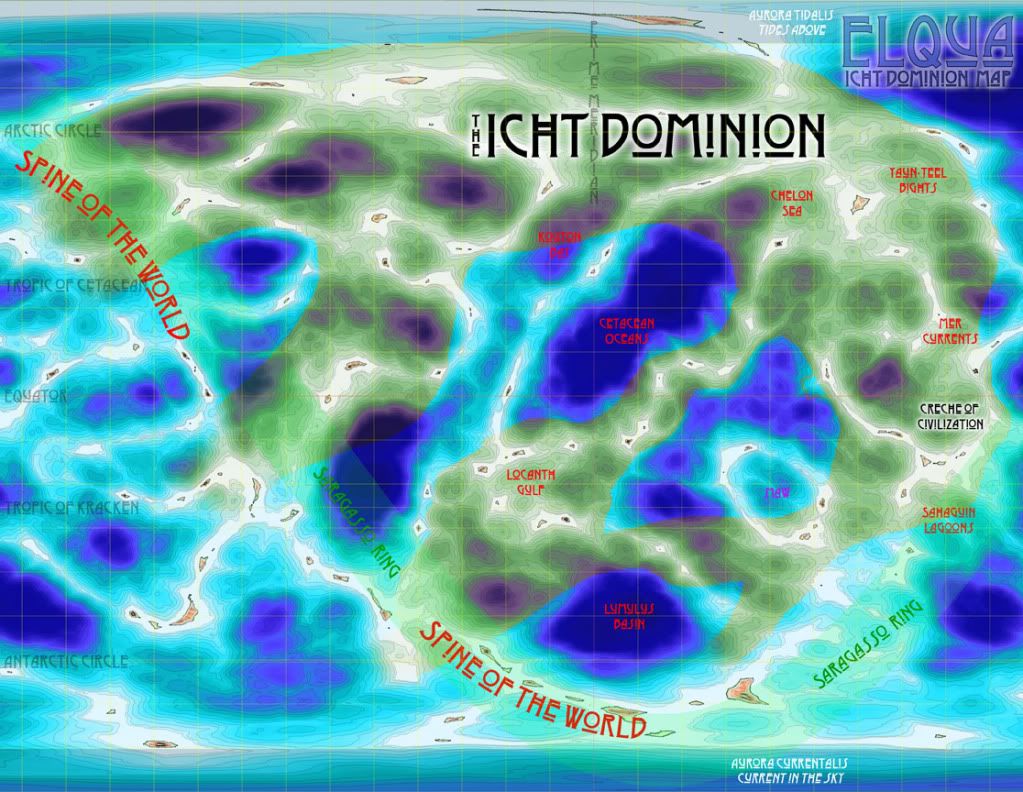
The Icht did exist, pioneering a society that started in the rich valley known as the Creche of Civilization, stretched across the northern parts of the Periphery and the Hinterseas, with minor arms of influence reaching southwest.  Their influence is believed to have reached as far as the mountainous barrier called the Spine of the World, or even further beyond.

The extent of the Icht Dominion during the heyday of their reign.

Map of the territory in the Known World believed to be under the purview of the Icht Dominion during the heyday of their reign.
The area said to belong to the Icht is a wavy, inconsistent coverage of the Elquan seas.  There is a conspicuous avoidance of truly deep waters, as if during their expansionist movement certain areas of the world were anathematic for them.  Perhaps they could not survive the harsh conditions of life of the Shelf, or maybe it was locations themselves that repelled the Icht rule, but the Dominion surprisingly flows around these areas like an aquatic fungal ooze.

The Icht were indeed the earliest known society to flourish in the clear, bountiful seas of Elqua, a highly advanced culture easily surpassing their contemporary neighbors who where little more than the primitives pisceans treat the Ceph of today.  The society apparently disappeared abruptly under unknown circumstances. There is no evidence of natural phenomena doing them in, such as famine or catastrophic effect.  Word of mouth retelling, passed down so many generations that the veracity is on par with a child's dream, states that one day the Icht were plentiful, and the next...  It was if they willed themselves to no longer exist.

Some of the few relics credited to Icht creation are some highly ornate masks. Broad and hemispherical, these half-mask covered the upper portion of the face and  gave it a roundish look that swept forward into a two foot long point above the lip.  Rectangular holes for the eyes are widely spaced apart, suggesting the Icht had to tilt their heads in order to look at someone right in front of them.  The mask are constructed from a type of dark quarried stone rich with shiny flakes, then apparently hand-engraved with a pictographic trim and polished to a glossy texture.  The thickness and expansive coverage of the face suggests the race may have aesthetically reviled their own visages, and worn these masks to hide appearances that would normally offend.  Scratching and wear on the inside of the mask where the forehead rested against the stone makes it plausible that these masks were worn at all times an Icht walked in public.  This conjecture is further reinforced by discovery of small infant sized versions among those larger ones.

There seems to be a general consensus of how the Icht looked, despite there being no record of their appearance from which to infer.  Perhaps some racial memory, or simply due to repeated mythology, but a definite morphology has been detailed.  Severly hunched-backed, the Icht stood not even as tall as a Mer, yet were as thick as the fittest Orcan.  Like the Lumulus, they possessed a chitinous plating, but it only covered their forehead, face, and jaw.  A second plate of armor grew as a stiff collar around the neck, jutting upwards from the shoulders and hovering over their bent backs.  Tiny, beady pupils gleamed from beneath the armored forehead, with smaller bones circling around their eyes almost like a segmented Orcan dirham.  Their lower jaw was a mandible that not only moved up to mold against the palette, but pulled to each side as the jaw parted at the chin.  Those jaws had a form of teeth but no true dentin -- instead large bone edges like meat cleavers jutted from their gums.  Their hands were stunted and spindly, barely able to reach their own face, and their tails tapered off to a point instead of the furled fins and flukes that are part of the piscean form.  Their coloration is cited as muddy browns and pale olive, a drab camouflage pigmentation that may have helped to keep them hidden from notice did nothing for their attractiveness.

The Icht are credited by their supporters as being quite advanced technologically than even the current state of the Fluid Nations.  For a body of water so spread out, they must have mastered the arts of domestication and aquaculture in order to maintain the populace's need for food.  There is no proof of what kinds of tools they had at their disposal, but some of the more learned postulate that the Icht are the ones that erected the mysterious Spurs in the Bronze Epoch.  There is little to support this line of thought, but neither is there anything to disprove it.  And if the Icht are not the ones that created them, then what race did?

Saturday, September 4, 2010

Endless Blue - Week 36.4 - The Spurs: Gemstone Bones of the Ocean Floor

Geography


Spurs: Gemstone Bones of the Ocean Floor

Perhaps one of the most anomalistic occurrences in the oceans, there stand the rare crystalline outcroppings known to only the most invested of historical sages as the Spurs. The lack of knowledge about these icons among the learned is nearly absolute, let alone any rumor that a laymer may have half-heard.  Most common pisceans will look slack-jawed at anyone asking about these enigmas, with the more facetiously pernicious spilling  great fonts of mercurial information for the price of one more cuprei lucrum.

Unknown to most, many of the civilized bodies of waterin the Periphery have at least one Spur inside their boundaries, though their locations are perhaps the most highly guarded secret the respective government keep.  Only in the Mer Currents has there never been found one of these monolithic growths.  Neither the Orcans nor the Chelon publicly admit to the Spurs existence but most assuredly have located at least one, and any discourse with the Lumulus results in an even more tenuous understanding of the phenomena that when you started.  Xantellaettes that a privy to the obscure lore of Spurs have noticed that never do ley lines and spur location coincide.  Whatever inference can be gleaned from this tiny morsel of observation is lost by the extreme jealousy that keeps the Spurs' existence from spreading.

Among the more primitive territories of the Hinterseas is another matter.  The Yaun-Teel Bights and Sahaguin Lagoons seem to share the same lack of Spurs as the Mer Currents, but the Kouton Bay and to a lesser extent the Gulf of Locanth have several.  The Kouton have them hidden away behind magic and mundane camoflague, even from each other.  The Locanths, in comparison, give them a wide berth, treating them with the same respect you would give to a venemous sea snake.  Even the migratory herds that the Locanth follow on their nomadic trek across their homesea avoid these places like the plague.  Locanth shaman will speak of the structures if approached correctly, but no consistent answer will ever be collected.

Beyond the familiar waters of the Hinterseas shows the prolific arrangement of these crystal plinths.  The farther west traveled, the greater the likelihood of encountering a Spur, but with so few explorers bitten with wanderlust their commonality has never been noted.  This is changing now, however, as the crowded nations of the Core push outward in the need for more breathing space.  Perhaps a Chelon xanthellaette might partner with a Kouton cartographer and one day map out the peculiar arrangement of these gemstone bones that stick out from the still sands like ribs of a long dead leviathan?

Another piece of the puzzle ruminates in the restless minds of the Godless.  Going against convention and risking deadly religious persecution, lone inquisitive minds of the loosely-knit movement have braved to peek above the waves and gaze into the Vastness above.  One of the multitude of incomprehensible sights that have been observed is an occasional refraction in the sky, a tiny sliver of expanse that seems to warp light like how an algae bloom spreads through the waters.  The Godless have taken to naming these prisms as "Shards", as they seem to scatter the light in the same manner that a cleaved facet from a jewel does.  Never has one of these airborne Shards been examined up close, but if the knowledge of the Spurs was ever to make its way into public domain, perhaps a link might form?

The current theorem of the origin of the glassy columns conjectures they are remnant artifacts of the ancient civilization known as the Icht.  Very little written material has survived from that time, but the Icht Dominion was credited with advances in technology far ahead of any other sentient race.  It is said their territory spanned most of what is now the Known World, and surely if they had not created the enigmatic pylons the the knew the most about them.

Spurs are difficult to detect until you are practically on top of them.  Perfectly transparent, they are nearly impossible to spy normally without something dark on the other side of them, its reflection refracted in the Spur.  Jutting out of the silt-lined ocean beds, they are always aligned perfectly straight, absolutely vertical, perpendicular to the horizon, as if bisecting the distance into halves.  Even in areas of geological turmoil, where the ground has shifted and bedrock lolls at inconvenient angles, these obelisks maintain their upright alignment pointing upward at the Vastness, almost accusingly.

Comprised of some unfamiliar, unidentifiable mineral, they have proven to be harder than diamond, and radiating an extreme, ephemeral cold that does not affecting the waters around them.  Slightly pyramid-shaped and conical, they stand taller than an Orcan, the six sides of these Spurs seem to just barely register to the naked eye as sloping upwards. so smooth to the touch they are nearly frictionless.

These slabs of simply faceted mineral are made of a clear, volcanic obsidian that seems to resist corrosion. Despite this, most are hidden by the slow encroachment of barnacles and coral collecting around them when they fail to attach to the clear, textureless surface.  If the accumulated detritus where stripped away, the surface would be seamless and featureless other than a single teardrop shaped indentation about the size of a thumb, approximately a foot below the top tip.

There have been many attempts at collecting the miracle crystal of spurs, but successful harvesting of the clear material has so far failed.  This does not prevent hucksters from trying to con the gullible from their lucrum with fanciful tales of how they came upon their rare stashes of spur-stuff that no one has heard of before now.  Most of these incredible new finds are the most common of quartz, cut haphazardly and ground together in an attempt to reproduce the convincing facade of age and naturalness.

"There are things you shouldn't know,
Things you aren't meant to know,
and then there are things others chose for you not to know.
I suspect these things are all three..."

-- a huckster's lure for the gullible, the vain, and the inquisitive.