Showing posts with label dearthsteel. Show all posts

Tuesday, September 7, 2010

Endless Blue - Week 36.7 - The Building Blocks from Under the Sea

Fabrication

Building Blocks from Under the Sea

Piscean settlements -- except for perhaps those of the nomadic Locanth -- are not a primitive clumping of lean-tos clustered together for safety.  Their buildings are permanent structures, planned and built not only to be a resilient form of shelter, but also as an artistic expression of vision.  The tools used in every day activities are similarly designed, with form and function melded together, embellished with as much ingenious craftsmanship as everything they create.  The materials available for construction are varied, having evolved from the basic bone, hide, and sinew of hunted beasts through the more robust harvested coral, quarried stone, and hydraulic mortar to the more exotic materials that in the hands of a master produce a masterwork artifact.

Exotic Materials

Presented are some of the more unique materials used by the civilizations of the Known World.  More commonly items that require flexibility are made of kelp, hide, or leather, and item that dictate rigidity are comprised of bone, stone, or mundane coral.

Abalone -- Abalone is another organically created precious material, this time constituting the inner lining of some shells.  The material possess a shiny metallic look which can be polished to a near-mirror finish.  Abalone items are carved from these reflective shells, so it allows for larger and more complex shapes than nacre.  Abalone items invoke cultural images of success and greatness, and as a result imbue the bearer of abalone items a bonus of +1 to leadership, though such items cost greatly more than their mundane counterparts

Cost Modifier
Type of Item
Speargun ammunition +120 gp
Light nautilus +10,000 gp
Medium nautilus +20,000 gp
Heavy nautilus +30,000 gp
Unguis +6,000 gp
Aegis +4,000 gp

Clear Quartz
-- This common crystal is called the assassin's jewel: good to pay a killer with, hard to find when a blade is made of it.  Blades made of quartz are difficult to spot in shadows, and the mineral crystal has the envious property of being transparent to ultravision.  The manner in which crystal grows makes it good for small, thin, flat or conical items unless an unnaturally large node can be found.  It is often used in windows, cut into into small tiles and arranged in a mosaic frame.

Cost Modifier
Type of Item
Speargun ammunition +12 gp
Light nautilus +1,000
Medium nautilus -
Heavy nautilus -
Unguis +600
Aegis +400

Dearthsteel
– Lumulan technology at the pinnacle of its achievement, dearthsteel is derived from the metallic remnants of meteorites.  These meteors formed in whatever catastrophe gave birth to the Sargasso Ring that orbits the planet of Elqua between Oberus and Ymaris.  Its unusual name comes from the rarity of finding the requisite ore from which to smelt the metal.  It is the only known ferrous metal that will not succumb to the normal oxidation of rust (though corrosion and acids will still affect it).  It is the equivalent to adamantite in the Endless Blue campaign setting.  The prices presented below are for previously existing items made of dearthsteel -- the Lumulus do not trade the material with outsiders.

Cost Modifier
Type of Item
Speargun ammunition +60 gp
Light nautilus +5,000 gp
Medium nautilus +10,000 gp
Heavy nautilus +15,000 gp
Unguis +3,000 gp
Aegis +2,000 gp

Jade
-- This mineral has a rich light-green color of semi-translucence.  It has a good hardness that can be cut in exacting degrees, making it excellent for minute carving.  Jade is found in portions of the Cetacean Oceans, Mer Currents, and the majority of the Chelon Sea.  Items made of jade gain a +1 to their hardness.  It can be used in both nautiluses and ungues, but due to scarcity and cost is is only used as an accent in construction.

Cost Modifier
Type of Item
Speargun ammunition +100 gp
Light nautilus +8,500 gp
Medium nautilus +17,000 gp
Heavy nautilus +25,000 gp
Unguis +5,000 gp
Aegis +3,500 gp

Lumulated metal
– Not a material in itself, Lumulated metal is more of a process.  A highly protected method of quenching metals that adds to its hardness and lightness, the process grants protection to the newly forged metal from the corrosive effects of water oxidation.  The tinge of color the process adds to the metal signifies which Lumulus forgeclan produced the item, which run the gamut of the spectrum.  The byproduct of this process enables spellcasters to imbue this metal with permanent magic; without it, dearthmetal remains stubbornly resistant to enchantment.

Forgeclan Lumulated Tinge
N’dlan’gisa
Red
G’dlu’mauex
Orange
T’dlang’athi Yellow
K’honk’coshe
Green
Q’oma’ithi
Blue
M’zims’he
Indigo
X’hamel’af Violet
J’warh’abvo
Ultraviolet

The J'war'abvo forgeclan made the ultimate sacrifice, bearing the brunt of the Kraken Empire in the final years of the war in order to bring lumulated dearthsteel to their ancient nemeses the Chelon for ultraviolet enchantment and finally break the stranglehold created by their occupier's unearthly camouflage abilities.  While this mating of technology and magic tipped the scales in favor of liberation, the Kraken wiped out every J'warh'abvo Lumulus before their ultimate fall.

Since then, a new forgeclan has slowly been building a formation.  This clan, based not on ties of blood but ties of ideals, has been maneuvering individuals into places of power in other forgeclans, waiting for a moment when the political climate is ripe for their public revelation.

The prices presented below are for previously existing items made with the lumulation process -- the Lumulus do not produce the material for outsiders.

Cost Modifier
Type of Item
Speargun ammunition +50 gp
Light nautilus +4,150 gp
Medium nautilus +8,300 gp
Heavy nautilus +12,450 gp
Unguis +2,500 gp
Aegis +1,750 gp

Nacre
-- Nacre is the hardened excretions made by mollusks and oysters to coat irritants trapped in their shells.  The perlescent sheen given off by polished nacre is uniquely beautiful.  Items can be inserted into domesticated bivalves and left to collect layers of the substance until it is completely covered.  The drawbacks of this art is that only small items can be fit inside the shell to be coated, and the process takes months and only produces a tiny amount of nacre.  The extra thickness added to items coated in nacre increase its dexterity penalty by +1.  Like abalone, nacre is traditionally a symbol of greatness, but more associated with the upper class than that of the common piscean.  Nacre items grant the wearer a +2 bonus to attempt of changing the attitude of those they speak with using Diplomacy.
Cost Modifier
Type of Item
Speargun ammunition +120 gp
Light nautilus +10,000 gp (chain shirt)
Medium nautilus +20,000 gp (chainmail)
Heavy nautilus -
Unguis -
Aegis -

Obsidian
-- Technically not a mineral, obsidian is formed by volcanic heat melting igneous rock into glass.  It cleaves well, resulting in a keen edge.  This makes it excellent for spear heads and other small lengths (too long a blade and it would snap in half).  The Lumulus Basin and Sahaguin Lagoons are festooned with deposits of volcanic glass, and the Sahaguin in particular make great use of it in weaponry.  Items made of obsidian enjoy +1 to damage from the razor-sharp glass easily slices through natural armor and toughened hide.

Cost Modifier
Type of Item
Speargun ammunition +24 gp
Light nautilus +2,000 gp
Medium nautilus -
Heavy nautilus -
Unguis +1,200 gp
Aegis +800 gp

Shell (Chelon)
-- This ghoulish material is the bony shell harvested from the back of a Chelon.  The use of a sentient species as construction material is repellent to nearly all the civilizations of the Known World, and as such are never seen in use outside of the savage Sahaguin, decadent Yaun-Teel, or barbaric Narwahl.  It does bestow a damage reduction of 1 to anything made from it due to the shell inherent resiliency.

Cost Modifier
Type of Item
Black Market only -

Shell (Lumulus)
-- This semi-rigid material is carved from the carapace of a Lumulus.  Unlike the shells of Chelon, Lumulus shed theirs as they grow and need not neccessarily require the death of the piscean to harvest it.  Despite this it still garners the same stigma that Chelon shell invokes.  Lumulus shell offers superior protection than that of Chelon shell, expressed as a damage reduction of 2, but offers no protection against bludgeoning weapons.

Cost Modifier
Type of Item
Black Market only -

Xanthellae
-- The art of coral shaping is sole province of the Chelon, and has been practiced for longer than written record or racial memory.  Through the generations of practice, the xanthellaettes have learned the secret to bending coral -- living coral, not the empty husk of coral used in construction -- into nautiluses, ungues, even buildings.  Items are formed rather than constructed, and the living material they are comprised of can regenerates damage at a slow rate (approximate 1 hit point per day).  The downside is that items must be contiguous, with no moving parts, so items like nautiluses cannot be removed.  Luckily the coral is porous, allowing the influx of water for breathing and the excretion of waste without hindrance.

Cost Modifier
Type of Item
By individual arrangement -

Friday, August 6, 2010

Endless Blue - Week 32 - Senses Despite Darkness

Spectroscopy


Senses Despite Darkeness


While life may have genesised from the water, it could not have begun there if not for the light bathing the world of Elqua from its sun.  Without that energy, the most basic link in the food chain -- namely photosynthesis -- could not metabolize, and sans a method of creating food the earliest phytoplankton colonies would have died from starvation.  Sans light, the smallest creatures of the oceans could not survive long enough to evolve into the immense and varied ecosystem of today.

In order for life to flourish, light had to be available for it.  On land light is plentiful, and even the most passive of biological constructs can soak in its bounty.  However, water is much less forgiving medium for transmission of light than air is, and some unique situations developed from the water's special qualities of reflection, refraction, and absorption.


Layers of Water

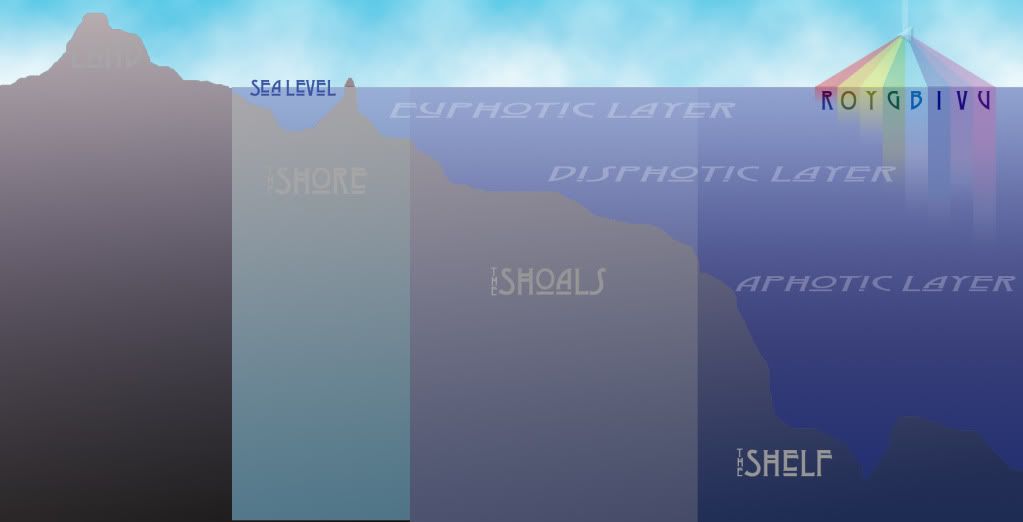
Just as there are vertical zones in the bodies of water on Elqua -- colloquially known as the Shore, the Shoals, and the Shelf -- there are also horizontal layers.  These layers are defined by the amount of light that can penetrate the depths.

The uppermost layer of the ocean is where almost 75% of all photosynthetic life on the planet exists.  Named the euphotic layer, it reaches about 300 feet from the sunbathed surface of the water.  By definition, the Shore is always in the euphotic layer.

Below this layer of life is the disphotic layer, it stretches downward to about 3,000 feet deep, and is dimly lit.  Animals can easily survive here, but it is rare for any botanical life to survive due to the inadequate amount of light to complete photosynthesis.  The Shoals reach from the disphotic layer up through the euphotic layer to the surface of the water.

Finally is the aphotic layer, where no light penetrates at all, and this layer accounts for a stunning 90% of the entire ocean area of Elqua.  The Shelf includes all three photic layers, the euphotic, disphotic, and aphotic layers.

Elqua's zones and layers intersect in a step pattern:
The Euphotic Shore The Euphotic Shoals The Euphotic Shelf

The Disphotic Shoals The Disphotic Shelf
Elqua's Sea Floor
The Aphotic Shelf


The layers of Elqua's ocean and the absorption of light spectra.
Color absorption roughly to scale; water depth is not.

That is a lot of water for light to shine through to reach the life living at the bottom of the sea.  But before the light can even start its journey through liquid, it has its first obstacle to overcome: reflection.
The water's surface has a property called albedo, which effectively reflects a varying amount of the light shining down onto it back into the atmosphere, affecting the planet's weather and climate.  The shape of the water's surface determines how much sunlight can penetrate through its surface into the depths below.  Rough waters reflect less light while calm seas reflect more.  It is the rolling tidal motion of waves that results in the wavy light effect that can be seen in shallow costal waters -- the wavering bands of light that dance along with the rise and fall of the waves.

Once the albedo barrier is pierced, light then has to penetrate through the optically more dense medium of water.  It is here that the individual portions of light -- the eight colors of visible light -- begin a process of attrition.  As light penetrates lower and lower depths of the oceans, the more difficult it becomes for white light to filter through the water.  Called refraction, it is the natural tendency of water to break up light into its component colors, which are thereby absorbed by particulate matter and the blue wavelenths are bounced off water molecules' own intrinsic though subtle shade of blue.

Colors with shorter wavelengths – greens, blues, and violets – are able to penetrate deeper into the water than those with long wavelenghts.  While eventually all color fades to darkness at the aphotic layer, the various colors can reach different depths.  Under the best of conditions (i.e., clearest water, sun directly overhead, etc.), red is the first color absorbed by the fluid surroundings; at a mere 15 feet red looks at best as a muddy sienna or burnt umber.  Orange is faded at 25', while yellow peters out at around 45 feet down.  Violet is absorbed at nearly 100 feet, followed by green at 135'.  Blue, curiously enough, is not absorbed until significantly deeper -- at about 300 feet.  This anomaly in the pattern is due to water's inherent blue tint, which scatters the blue wavelengths of light instead of absorbing them.

Note that these distances are measured from the surface of the water directly to the colored object.  The distance from that object that an observer views from is cumulative for determining what color wavelengths can be discerend.  Thus:

Object's distance from surface + object's distance from observer = total distance of color absorption.

For example, a Mer gazes at a goldfish from ten feet away from him, and they are both ten feet below the surface of the waves.  The light from the sun penetrates the water's albedo and travels 10' to bounce off the goldfish and then travels an additional 10' to reach the Mer's eyes.  That's a total of 20', which is coming close to orange's maximum absorption point.  The goldfish's color would appear muddy and bland in the surrounding blue.  Had the goldfish been green, however, its coloration would still have maintained its vividness to a point where the distances between the Mer. the "greenfish", and the surface of the ocean equaled approximately 135 feet.

This demonstrates the benefit of portable sources of light beneath the waves.  Bioluminescence is a poor but unfortunately the sole viable source of light generation under the sea.  Shedding light barely greater than a lit candle, it can barely illuminate the immediate area with its weak radiance.  Stronger light sources can be achieved through alchemy, and these light sources make discerning colors much more practical, and the distance light travels would use these alchemical lamps as the starting point to measure color absorption instead of the surface of the water, effectively exposing color to layers of the oceans that cannot normally be appreciated.

With vision such an integral sense for exploring one’s environment, other methods of “sight” evolved to fulfill the role of the primary sense.  Such established methods like infravision still exist in Elqua, though in this case infravision is severely truncated due to the light- and heat-absorption properties of water, and so is only useful on the surface and in Shore areas where light is barely refracted.

Dive deep enough, all color eventually disappears, leaving most creatures in the dark without any wavelength of light to stimulate their optic receptors, save for the ultraviolet.  Water is perplexingly transparent to ultraviolet rays, which can reach down to almost the aphotic layer.  What this signifies is that even though these depths would appear as an almost inky blackness to our eyes, there is still enough light to see with eyes that can peer into the ultraviolet range.  Perhaps the most successful adaption to deal with this depth-blindness was the evolution of ultravision.


Ultravision

The Kraken’s innate camouflage abilities, while formidable, would make it difficult to find others of their own kind if they did not possess a form of vision that enables them to spot each other despite their best disguise.  This sense -- known as “ultravision” -- works on the principle that while camouflage tends to be uncanny in the visible spectrum, the chemicals used to duplicate the natural coloring of the surroundings do not share the same make-up as the surroundings.  While skin tone can be recreated in a painting, the pigments used in both complexion and paint are not the same compounds, expressing different properties when exposed to the proper stimuli.   In this case, light.   When exposed to a special light source, these chameleonic pigments fluoresce whereas the natural coloring of the surrounds remain unlit, making detection as easy as looking in the right direction.  However, ultravision is a passive medium. meaning it is dependent on an outside source to function correctly.  Ultravision would be a useless quirk of vision without special illumination, and such sources are immediately detectable by those that have ultravision as if it was a normal light source of the same size.

It wasn't until the historically antagonistic Chelon and Lumulus both realized the Kraken Occupation was a greater risk to their survival that either one of them were to each other.  The despite that propelled the Shellback Wars to wage over and over had to be put aside for the greater continuation of piscean life.  Only the Chelon's mastery of mystic might and the Lumulus' expertise at smithing metal could come together to form the ultimate tool for freedom -- ultraviolet enchanted dearthsteel.

Unguis/Nautilus Abilities


Ultraviolet
– An item with this quality gives off the kind of ultraviolet light that enables ultravision to work.  The magical bonus equivalent bestowed on the item by the enchantment varies according to the intensity of light shed: from +1 for a glow of a candle to +5 for the pure amount from full sunlight.  Further, an item’s size also limits how bright a glow the item can cast.  Tiny items such as daggers can only shed the weak +1/candlelight equivalent amount of ultraviolet light, with the capacity increasing by +1 for every size type larger an item from there.

Unguis/Nautilus Bonus Illumination Level Illumination Range Unguis/Nautilus Size
+1
Candlelight 5 ft. (Shadowy) Dagger, bracer, buckler
+2
Lamp 10 ft. Short Sword, halmet, cestus
+3
Dancing lights 20 ft. Longsword, half-spear, shield
+4
Lantern 30 ft. Spear, quarterstaff, large shield
+5
Sunlight 60 ft. Polearm, Lance, double weapon *, tower shield
* -- Except quarterstaves.

Ultraviolet Burst
-- Upon a successful hit on (for an unguis) or hit by (for a nautilus) a target capable of camouflage, the striking/struck item releases a massive momentary burst of ultraviolet light that stuns the pigment producing cells and temporarily stuns them for 1d6 rounds.  In order for an item to be enchanted with ultraviolet burst it must already possess the ultraviolet ability before it can be give ultraviolet burst.  It is a +1 bonus equivalent ability.

The magics needed to permanently enchant ultraviolet abilities seem unable to anchor themselves to xanthellae, so the war ravaged Chelon needed some other source to attach their spells.  Conversely, no Lumulan has shown the ability to coral shape, so they lack the mental discipline to cast the ultraviolet spells into their own metal, dearthsteel.  Through espionage and betrayal, threats and machinations, the Kraken had for the most all of the occupation kept the two shellback races at each other's throats.  It was finally the Orcans that mediated a cease fire if not peace long enough for the two arts to merge into the last chance the Known World had for freedom.  So unprecedented was the merging of these two quarrelsome factions that the alliance had as much to fear from internal back-stabbing as it ever had from their encephalopodic enslavers.


Echolocation

The aphotic Shelf, where the water is so deep that no light reaches, requires other senses to take up the slack from the now useless sense of vision.  The foremost among these is echolocation.  Most notably expressed by the cetaceans, it is an active system of vocalized “pings” that radiate out through the water and are reflected back when they come in contact with objects.  The reflected sound will sound slightly different in each ear as the soundwaves bounce back to the caller, and it is this stereophonic effect that gives the creature the ability to envision his environment around him in full three dimensional perspective.

The primary organ used in echolocation is the melon.  This is a roughly ovoid shaped organ found in the forehead of such creatures that can located by sound.  It is the melon that gives the Orcans their broad forehead and prominent brow.  The interior of this fatty organ is coated with a waxy oil called parmaceti, which is used in biosonar as both a focusing apparatus for the initial sound and as a receptor for the reflected sound when the consistency of the fatty tissue matches the surrounding environment, aiding in the transfer of sound vibrations to the inner ear.

Since sound travels better in water than through air, this is an effective method of vision.  However, since it requires the possessor to actively create sound pulses, creatures with echolocation can be detected by any creature through a simple passive Listen check with a Difficulty Class of 15.  An interesting side effect of this is that any creature with echolocation themselves can use the pings of active echolocation to determine the distance and direction of the sounds origin.

This curious discovery was frequently used by the Orcan barbarians, whom would spread out to surround an enemy on all sides, then a single warrior (usually the pod alpha) would make a whalesong that all others in the pod used to determine the whereabouts of the pursued prey.  From this, the Orcans learned that their whalesongs need not be the source of soundwaves detected by their melons, and have adapted to using other sources of sound as their "ping".  This takes a Listen check at a DC of 20 to succeed, with a modifier of +1 for every mile distance the original sound is made.  A failed test cannot be rerolled, but new rolls can be made if the sound lasts for more than a round or is repeated.

Rumor has it that some special Orcans have learned the ability to use echolocation without the need to generate an echo, relying instead on the ambient sounds that fill the oceans constantly.  Most like such stories are tall tales told to magnify the cetacean's sense of glory, as no Orcan has ever demonstrated the ability.


Currentsense


Currentsense is similar to echolocation, but disparate in two key areas: First, currentsense works on the sense of taste instead of hearing, and Second, the sense needs only a moving trickle of water to operate.  Without some form of currentsense, it is nearly impossible to track a target effectively in a featureless, three dimensional environment.

The most primitive form of currentsense is called bloodtrace.  This is the sense that sharks possess, the ability to detect even the smallest traces of blood in the current from great distances and home in on their origin.  Creatures with bloodtrace gain a +5 circumstance bonus when tracking a bleeding target.
The second form is called tracescent, and it operates like bloodscent, but can detect a greater range of trace compounds dragged along the currents, like recently consumed food or bodily waste.  The +5 circumstance bonus from this method of currentsense extends to any substance that leaves a residue for the currents to carry away.

The final form, true currentsense, can detect its surroundings purely by the eddies it has caused in the current. The character’s sense of touch has become so acute it can feel the lightest eddy or divergent current around him.  Similar to the tremorsense ability many of the eyeless aberrations above the waves exhibit, it allows the character to comprehend its surroundings completely without the benefit of sight.  These individuals are to be treated as if they could normally see in a well-lit area of sunlight, and enjoy the +5 circumstance bonus to tracking regardless if the target is leaving substance traces behind or not.

None of the primitive nor civilized races of the Known World of Elqua possess a form of currentsense, though they may temporarily gain them through magic or employ domesticated animals that themselves have the skill.  Such animals are highly sought after, and packbreeders have been known to be able to improve the currentsense in successive generations of those species.
"Swim fast; swim silent; swim deep."
-- the best advice for swimming closer to the Source