Showing posts with label sociology. Show all posts

Friday, October 22, 2010

Endless Blue - Week 43 - The Art of Submerged War: Navies of the Known World

Sociology

The Art of Submerged War: Navies of the Known World

The Known World of Elqua may have a superficial resemblance to a placid paradise, but nothing could be further from the truth.  The Fluid Nations have been at war with one another for most of their history, and only recently as there been any relative peace between the powers.   The Cerulean Era is name such for the very fact that the Endless Blue had entered into a period of unprecedented peace if not prosperity.  But that idyllic time is coming to an end, as the homeseas have grown too large for their borders, having slowly settled outward into the treaty-enforced spaces between countries called no mer's seas.  Skirmishes have begun as swimming space dwindles and foraging territories shrink.  The voices of the growing populaces are loudly demanding more water, more space, more freedom, but there is no more un-proportioned water to be had without expanding outward into the influences of their neighbors.

Only the civilized races of the Periphery have a standing navy, or even the infrastructure to support one.  The Hinterseas of the Kouton Bay, Gulf of Locanth, Yaun-Teel Bights, and Sahaguin Lagoons seem to be easier prey, with their less sophisticated cultures and more primitive armament.  The Laws of Fluid Dynamics would tell a society quickly outgrowing its alloted space to follow the path of least resistance, to enact an expansionist campaign outward against their primitive but ruthless neighbors.  But there is also the lure of moving inward to the Core.  For those brave (or ignorant) enough to ignore the superstitious fear of the Ruins of the Kraken Empire in the Maw, there lies the ancient pearl of the Elquan oceans, the Creche of Civilization, unused, uncontrolled, just waiting for the ambitious and the powerful to claim it as their own.

The Endless Blue Navies


It is little surprise to learn that in the culture of the martial Orcans it is expected for all citizens to serve at least one term in the the Orcan Naval Force (ONF).  The ONF is a alliance of city-state militias that serve as local law enforcement as well as a military reserve.  As much a part of their culture as their training, soldiers in the ONF understand that they must work together for the greater benefit of the Orcan government.

To achieve this aim, the ONF operates under the same "Eight Banner System" as the Cetacean Barbarian hordes of their history.  The military force is based on the smallest unit, an 8 Orcan group called an arav.  Eight of these aravs forms a zuut (64 soldiers),  with eight zuuts making a minhan (512 soldiers), and finally eight minhans completed a tumen (4096 soldiers).  Any number of tumens formed an ordu, the mispronounciation of this being the origin of the word Horde.

Ranks -- Khan, Noyan, Boyan, Ongul.
The Chelon navy if formally referred to as Her/His Majesty's Royal Armada, or HMRS.  It is comprised of a number of legions overseen by tribunes, whom in turn report to the legate placed in charge of them by royal decree.  A legion is six cohortes, which in turn is broken into six centuries of 60 to 180 legionaires.  These centuries are divided into a number of ranks dependent on the current military objective, a designation that refers to the ordered arrangement of legionaires into lines.  Each line is the equivalent of a unit of soldiers.  A Senate of Legates oversees the direction and deployment of the legions.

Ranks -- Legate, Tribune, Pilus, Centurion, Legionaire
The Lumulus Maritime Self -Defense Force, or LMSDF, are a decentralized military organization that works in cells across the surviving forgeclans.  These cells are not secretive, but the organization of who reports to whom is so complicated to the non-Lumulus that it is impossible to trace back to where orders originate.  Any one unit of the LMSDF only knows the unit above (and below at higher ranks).  This protects the chain of command from infiltration, as well as the individual Lumulus as their knowledge is always limited.  This strange, seemingly limiting method of letting soldiers "know only what they need to know" has kept their military particularly insular, and is one of the major reasons that the fall of the Kraken Empire could be achieved.

Ranks -- Unknown
The Mer Currents maintains a force called the United Marine Command (UMC).  The UMC is a multi-layered organization that starts with the shoal.  A shoal consists of 6 soldiers with an attachment of 1 packbreeder.  The consistency of these shoals varies greatly, dependent on the combat specialty for which the shoal is intended.   Infantry based shoals would be warriors with a packbreeder controlling beasts of massive builds, while a reconnaissance shoal would consist of scouts and a packbreeder guiding highly swift creatures.  Special shoals comprised of spellcasters but are not common and are normally part of a special branch, either the arcane or medical corps.

From there 2 to 4 shoals form a School, and 2 to 4 schools form a Company.  These companies typically take on colorful names as a traditional method of instilling pride and belonging into its constituent soldiers.  Further up the chain of command, 4 to 8 companies forms a Flotilla. and 2 to 4 flotillas makes a Brigade.  A Division is a pair of brigades, and 2 to four division forms a Corps.  Beyond that is only the highest military leaders, with the entire Fleet under their purview.

Ranks -- Fleet Admiral, Admiral, Rear Admiral, Commodore, Captain, Commander, Lieutenant Commander, Lieutenant, Junior Lieutenant, Ensign.

The Yaun-Teel, like everything else in their culture, relegates the need to maintain an armed services to private mercenary companies.  It is a business to them, like anything else they do.  There is no such concept as "patriotic duty" for the Yaun-Teel.  Instead, it is fulfilled by the work ethic expressed by the soldiers of the mercenary company.  This does not mean no Yaun-Teel ever feels the need to step up and lay down his life for his country, but it does mean that each mercenary company works independently of each other.  Hundreds of such organizations exist in the Bights, selling their swords to the highest bidder when there are brief respites in the waging of war between nations.

Ranks -- Per mercenary charter.
The other three primitive races -- the Kouton, the Locanth, and the Sahaguin -- deal with war and invasion on the local level, with each settlement taking on the responsibility of keeping its constituents alive.  While their homeseas are recognized as sovereign nations, they possess little in the way of a central government to lead them.  For issue of tsunami-level importance, the races generally hold a meeting of the elders, those individuals with sway and the means to enact others.

Ranks -- Not applicable.
"War spares neither the brave nor the cowardly: The brave are killed to wage and the cowardly are killed by the brave."
-- Unknown

Friday, October 15, 2010

Endless Blue - Week 42 - Garment Couture: The Fashion Aesthetic

Sociology

Garment Couture: The Fashion Aesthetic

Elquan fashions favor the simple over the complex.  While craftsmen are more than capable of (and do) producing the most intricate of work, the tendency of water to obscure light and detail means such astounding detail is lost.  Clothing and jewelery with fine detailing can only be appreciated in the Shore areas, where light can most easily penetrate the water's natural absorption.  As a result, many refer to those that wear detailed clothing and finery as "wanting to be deep fish in the shallows", referring to the vain desire to appear imposing in one's small area of influence.

Textiles

Fabric is a well known technology beneath the waters of Elqua, with records of woven fabrics dating back to the Bronze Epoch.  While cloth of that time originally had only the natural coloration of the plant or animal material from which it was derived, eventually dyeing became possible with mated containers.

All cloth is made on machines called looms, a moving interleave of thread that meshes together to form a continuous plain of fabric.  Thread itself is an extension of the creation of rope, refined and reduced to a more manipulative state.  Thread is comprised of the fibers of plant matter and/or the hairs of hairy aquatic mammals*, spun around each other to form a contiguous length of string.  The thread is then loaded into the loom which forms a criss-crossing lattice of interwoven threads.  The product is cloth.
A variety of cloth (and supple leathers) are used in Elquan fashion.  Indeed, cloth weaving is not limited to just organic materials.  Lamé -- a fabric made with a metallic weft --  uses a thin metallic yarn that is wrapped in a metallic wire or ribbon.  So fine and skillfully spun is this mineral thread that is becomes nearly as ductile as cloth without loosing the luster of precious metal.

Hides and skins of sea fauna are also used in the fabrication of clothing as it is in the creation of nautiluses, but where the latter uses tanning methodology that produces stiffer material, the former concentrates on softening the skins.  Fish skin comes in a wide variety of natural coloration and scale composition, and these gradations are used by seamstresses to produce incredible works.

Articles of Clothing

Clothing is the shaping of fabric into objects that can be worn on the piscean body.  Not every species in the oceans is equipped to survive in varying temperatures, and as such sometimes need extra protection to shield them from the elements.  Over successive generations clothing has evolved from just being "shelter that is worn" into an expression of art, tradition, culture, and personality.

Cap-- This is a generic catch-all term for anything worn essentially on the top of the head.  They can be kept in place by any manner of means, be it a tight headband, pinning in the hair, or strapped under the chin, jaw, or ears.
Choker -- A choker is like a necklace, but instead of hanging loosely down from the neck and shoulders, it is more snugly around the throat (but not too tight as to constrict breathing or swallowing.  It can serve the same role as a belt and can be what keeps the chemise (below) in place, but is differentiated by the need to keep the weight demands low as to prevent choking.
Chemise-- A chemise is an article of clothing that covers the torso of a piscean.  They may be as form fitting or formless as desired, and they need not include sleeves -- but may have them at various lengths, also either tight against the arms or more loosely draped as taste dictates.  The creation of chemises always needs to keep in mind the location of the picean gills along the lower ribs, and must keep that area free of obstruction lest they endanger the wearer with strangulation.
Glove -- The piscean glove is a bit more complicated than the gloves of our world.  Most pisceans have varying lengths of webbing between their digits, and natural ungues at their tips.  While this stretch of skin aids in swimming, it makes tailoring gloves more difficult.  A slit is cut in the fabric of the gloves where each finger connects to the hand and is extended outward to the second or third knuckle.  A piece of cloth is then folded over and sewn into the hem of the slit, and the seem is reinforced with stiffer materials to keep the glove form fitting.
Belt --  A loop around the major axis of the piscean body, belts are perhaps the most varied of all the articles of clothing.  They can vary in ever conceivable way -- thickness, width, tightness, color, even the method of wear is exceedingly flexible.  While traditionally worn perpendicular to the central anteroposterior axis, belts can be jauntily skewed over the hip, across the chest like a bandoleer, or even interlocked like a harness.  They are the most functional part of Elquan dress and the most universally utilized in every way of life.
Ephod -- The ephod is the article of clothing that covers the main trunk of the tail.  Like the shirt, it can be as basic as a cloth hanging from the waist to as complicated a network of interwoven fibers enshrouding the tail.
Caudalet -- Much like the choker, a caudalet is worn around the end of the tail right before the tail fins spread out from the piscean form.  Also like a choker, a caudalet can be used as the connective part of the lower end of an ephod or to anchor tail flippers (see below).
Flipper -- The lower counterpart of the glove, flippers are pieces of clothing worn over the pelvic and/or tail fins.  They are usually made of sterner stuff than gloves, as they must endure the constant wear of continual swimming.
Accessories

Accessories are differentiated from clothing in that they are usually comprised of harder materials than fabric, usually metal.  This material would be uncomfortable, even detrimental to the wearer is used like cloth.  They are instead used to accentuate and supplement the garments worn by a piscean.  Common forms of accessories take the form of jewelery such as earrings, torcs, bracelets, and rings.  Elquan tailors have taken to incorporating jewelery into their garment designs, making buttons, clasps, and buckles decorative as well as functional.  Other materials used in Elquan jewelery is abalone, crystal, gemstone, sea shell, and perhaps the most pervasive accoutrement of all, pearl.

Fashion by Historical Culture

Culture enforces as much influence on fashion as whimsy does.  Areas of high ethnic concentration will contain greater numbers of  traditionalists, whom bring the "old ways" of dress with them.  Part of being accepted into a society is the adoption of their customs, and adopting the apparel of the local populace is the primary visual means of integration.

The Yaun-Teel maintain a practice among their orthodox members of keeping their bodies fully clothed as much as possible.  This sets them apart from their slaves, whom are usually divested of all clothing early on in a method meant to humiliate and break the will of their "indentured servants".
With their culture very much entrenched in the martial tradition, it is unsurprising to find that the Orcans in a martial fashion, incorporating nautiluses into a style of dress that expects the struggle for life and death to erupt at any moment.
In many ways, the amount and intricacy of clothing worn by the Chelon is an indication of their social standing, with the more powerful and affulent affording complex outfits that fly in the face of function.
The Ceph both eschew clothing and are rebuked by it.  Their non-piscean forms make many of the articles of clothing useless to them, which is just as well as it would interfere with their natural camouflage abilities.  Ceph clothing must be specially made for them, usually consisting of a huge glove with eight fingers on it, caps, and belts.
Locanth and Sahaguin, cultures diametrically opposite oceanographically as well as philosophically, strangely share a common aesthetic when it comes to clothing.  They will dress pragmatically, opting for clothing that is functional for an intended purpose.
The strange Lumulus connect their clothing directly to their chitinous exoskeletons, anchoring them with piercings in the hardened plates.  Their quizzical clothing incorporates the unique metals that their culture is renown for into a way of dress that is both clothing and jewelery simultaneously.
The Mer are the most mercurial when it comes to clothing, as they are a species fascinated by fashion.  Fads come and go across all of the Mer currents quicker than a Kouton hides a secret, and they take their inspiration from whatever aspect of the mode of dress from other cultures strikes their fancy.  What is chic one day is dull the next, and whatever little feature of culture that captured their attention at one moment could cause social expulsion by the time you learned of it.
Speaking of the Kouton, they prefer to wear loose fitting robes and cowls that cover most of the body, obliterating any distinguishing features that may betray knowledge to others.
"Clothes make the Mer, so long as other make the clothes..."
- a snide comment on the way Mer reputation for dress.
---
* -- Despite being referred to as "mammals", these animals do not require air to breathe.  Like the cetaceans and dolphinidae of the setting, aquatic mammals have gills and never developed the blow hole, nostrils, or any other form of in taking the atmosphere into their bodies.

Friday, October 1, 2010

Endless Blue - Week 40 - The Resurrectionists: Tailors of the Fabric that is Flesh

Sociology

Resurrectionists -- Tailors of the Fabric that is Flesh

Purveyors of the dead, dealers in dark magicks.  These are what the populace would call necromancers, dabblers in the animation of corpses.  But those that seek knowledge of the dead prefer the more neutral title: Resurrectionists.  Despite the conjured image of twisted souls perverting the sanctity of departed love ones to serve out some abstract nefarious goal, the Resurrectionists actually employ their misunderstood art for the betterment of the water world as a whole.  One part caring healer of the sick, another part environmentally conscious recycler, and a final part questor for eternal life, the Resurrectionists see themselves as the answer to the Known Worlds current problems.

Anatomy of an Anatomist

The beginning of the Resurrectionist movement lay partially with the creation of the scientific method of medicine.  To better understand how to combat infirmity and impairment, a healer must understand the underlying principles of biology.  Resorting to battlefield chirurgy can only reveal so much, with the mangled flesh and expended lives strewn across the waters like so much chum.  What few specimens were not scavenged by wildlife or ravaged by saltwater were hardly the best material from which to learn the secrets of how the piscean body works.  They needed better cadavers to examine, fresher bodies to dissect, in order to delve into the mystery of biology.

They turned to the packbreeders of Elqua, asking for the bodies of their expired warbeasts for anatomical research.  In exchange, the Resurrectionists shared insights with the donors to better breed their stock.  This arrangement worked well for both parties, and the knowledge of biology was furthered by fathoms in a reconnaissance of discovery.  But just as the small window of opportunity on the battlefield were mined of all their secrets, so too did the dissection of fauna eventually peter out of insight.  The Resurrectionsists had to face the truth they wished to avoid -- they needed intact, practically fresh piscean bodies.

The integrity of the dead is sacrosanct in nearly all Elquan cultures, and the rites that must be observed to properly ensure the passing of the dead are strict.  Foremost among them is the taboo against desecrating the body.  All dead are to be weighted and consigned to the depths, to sink further and further into the darkness below to become one with the Source.  Even the other religions such as Olyhydranism and Pantheon worship still command their schools to send their dead to the center of the globe.  The mere thought that the body of a loved one would not be weighted and sunk, thus forever barred from returning to their Creator, horrifies the piscean races.  But this tradition of burial is essentially throwing away perfectly good research material to a Resurrectionist.  It was such a loss each and every time blind superstition overrides the potential medical discovery that the Resurrectionists made a desperate move...  They began to clandestinely pay for bodies.

It was a shameful but unavoidable decision.  It had to be done, and to this day the Resurrectionists pay the unscrupulous and nonspiritual to "rescue" weighted bodies for later experimentation.  Delivery of the bodies had to be in secret, with utter discretion and no questions asked.  So long as the body thieves kept quiet about their clientele, the Resurrectionists asked no questions of how or where the bodies were collected.  With this unspoken pact in place, it was not long before the grave robbers began to offer "dead contracts".  Targeted at the desperate and poor, dead contracts were a formal if illegal agreement that the signer would receive payment now, interest free until the day he dies; at which point, the body of the deceased then becomes the property of the signor.  This trafficking of yet-to-be-dead bodies has not gone unnoticed by the authorities, but they can do little about it when the victims are too afraid of the body thieves to come forward.

As this financial arrangement became more and more lucrative, the Resurrectionists improved their healing skills and began to make a name form themselves.  This led to the formation of the guild known as the College of Doctors, established as an organization that garnered the fame from their successful medicine that could never be achieved under the banner of the Resurrectionists.  The organization has grown, diversified, and spread across the Known World.  So large is the organization now that most have no clue of the group's less than ethical beginnings and newly inducted members see it as the idealistic philosophy that the Resurrectionists pretend to be.

Pragmatism vs. Atheism

There is a confusion in the minds of the less metropolitan that the Resurrectionists and the Godless are the same philosophical movement.  This is simply not true.  Granted, Resurrectionist  share much in common with their atheistic counterparts, but the two movements have sharp distinctions.  The Godless espouse that the gods are false, while the Resurrectionists assert that the dead have no need to be revered.  Resurrectionists believe that once the body dies, the animus vitae-- the force of life -- is gone and what is left behind is so much scale and bone.  Whether the force of life simply dissipates or moves on to join with a creator is only of ancillary concern to these animists.  In contrast, Godless do not believe there is a Source or any other creator that collects souls, but life is still precious for the simple fact that it is the only thing in the universe that fights entropy.

Resurrectionists are not evil, and do not view what they do as an abomination against nature.  They are pragmatic, rationalizing that the departed have left this world behind. With their mortal shell cast aside as useless, there is not moral ambiguity in others using it as a natural resource.  It is little different than the piscean use of aquatic flora and fauna as food -- there is not cruel intention in the consumption, just the natural balance of life taking succor from the waters around it.  They would no more blink an eye at using the remains of a piscean as a miner has digging ore from the seabed or a culinist harvesting seaweed from the kelp fields.  It is simply a matter of pragmatism, using what exists as the tools of survival.  Societal mores make their activities taboo, but ethically it is no more antithetical to life as cutting coral for construction of shelters.

The Dead that Swim Once More

Many secrets owe their discovery to the questionable endeavors of the Resurrectionists.  They have contributed to more medical innovation than all other physical arts combined, and those breakthroughs have brought results that would have been declared miracles in earlier ages.  Indeed, it is their study of nature that gave them the ultimate lore -- the ability to make the dead move.

This unique talent traces its origins back to the earliest piscean archeologists whom took a second look at the strange formations in the rock bed.  Once simply regarded as an odd form of pareidolia, it was these early proto-Resurrectionists that realized the stone were actually fossils, petrified remains of living creatures that swam the oceans of Elqua epochs in the past.  They began to excavate these stony bones with an obsessive determination that their kinds still suffers under to this day, collecting the parts, arranging them in various orders as they postulated skeletal arrangement and musculature.  With the advent of Seamus Lorwynn's theory of evolution, they postulated the biology of the past to have parallels in the past, and used the morphology of modern sea monsters as a guide to model the prehistoric creatures against.  Ligaments, muscles, organs, flesh...  all masterfully plotted out in the minds of these imaginative and intuitive individuals so clearly and concisely they could practically make them move as they had when they were alive.  One day, they actually accomplished it, and the first living dead, or golem, was created.

The undead that Resurrectionists animate have more in common with puppets than the unliving, and a distinction must be made between the unliving that Resurrectionists create and the undead that seep down from the Vastness.  The former are vile aberrations of life, fueled by some unquenchable fury to destroy the faintest trace of animus vitae.  The latter are mere animated slabs of meat, muscle tissue given inertia through memory.  These undead are in actuality golems made of flesh and bone, stone and scale.

The first golems were primitive things, made of fossilized bones and clay flesh, lashed together with seaweed and hide, enshrouding a tiny flicker of animus vitae.  They possessed no grace, no beauty -- they were as ugly in sight as they were in function.  Those primitive attempts at bringing to life what was lifeless were things of horror and revilement.  It is no wonder that even today the Resurrectionists must keep their natures hidden from the light of day.

As techniques were refined, the most common form of golem was and still is the homunculus.  Small approximations of the piscean form, they look more like marionettes that living flesh.  But they were the first of the living dead that were imbued with intelligence, albeit rudimentary.  From those lowly beginnings, the Resurrectionists sought greater and greater achievements in the art of reanimation, growing in size and breadth and reach with each passing year.  Word of their discoveries have come under scrutiny of local lords, even the racial governments have looked closely at the potential for "rejuvenating soldiers" that reanimation promises.  Images of highly skilled and utterly loyal Royal Medic Corps being assigned to the regiments of countries' navies, attending to any of the wounded that were beyond saving, applying their craft there on the battlefield.  The details of what those medics would actually be performing are usually glossed over, but it takes little imagination to realize the result would be the cannibalization of the terminally wounded into cobbled together yet functioning soldiers.  The admirals in charge cling to visions that the worst of such behavior would be relegated to the fallen warbeasts of their forces, and are willingly turning a blind eye to the repugnance of the truth.

And with the borders becoming ever so much more restrictive, the conscription of Resurrectionists into the territory wars may be nearer than anyone realizes.

The Paragon Cynosure

Practitioners of alchemy have their Philosopher's Stone; the faithful have their Holy Grails.  There is a equal ultimate achievement among the Resurtectionists, sought as zealously as the Grail and as greedily as the Stone.  This cynosure of all Resurrectionists is nothing less that the resurrection of an extinct species.  Not the paltry animation of golems, but the restoration of the animus vitae in a species that has long ago gone extinct.  Treatises through the generations have posited on what that would mean, ethically, morally, spiritually, but most modern practitioners of reanimation begrudgingly agree that the paragon cynosure, the ultimate expression of resurrection, is to bring back a dead intelligent race.  Nothing else fits the bill better than the mysterious and infamous Icht.

Friday, September 24, 2010

Endless Blue - Week 39 - The Free Olympiad

Sociology

The Free Olympiad

The spirit of competition, distilled in the phrase "Faster, Stronger, Freer", has inspired the races of the Endless Blue to great achievements of body, mind, and soul.  Nothing embodies the motto more completely than the physical challenge known as the Free Olympiad.

The Olympiad, ironically enough, had its roots in the Kraken Occupation.  The cruel invaders would take troublemakers and leaders -- individuals that had the potential to galvanize the subjected homseas into a rebellion -- and force them into arenas to fight for their lives.  Either against captured predators or other rabble-rousers, they were often subjected to heinous and humiliating shows of violence for the entertainment of the Squid.  The popularity of these fights grew as the years passed by, with slaves and slavers alike rooting for their favored to win.

After the Kraken fell from the grace of their alien gods and the shackles of Occupation were smashed, the arenas remained.  Those in the Periphery were sites of rebellion, when the most experienced of gladiators threw off their yokes and led their fellow slaves to freedom.  The immediate reactionary sentiment was to destroy them all, eradicate any and all relics of the dark chapter of Elquan history in an effort to banish the memories.

And many were.  Some of these buildings were razed in the mania that followed their liberation, but others served as the headquarters of further resistance.  Their utilization as infrastructure for the resistance was extended to post-freedom assistance.  Maintaining these places as the center of liberation transformed them from memorials of past torture into edifices of freedom.  They essentially became symbols of the freedom the sentient races strove to achieve.  So when that freedom was finally won, there was question of what to do with the remaining structures.

The Traditions

The Everglow -- The most well known ceremony of the Olympiad, the Everglow is a metaphorical tradition representing the unending will that perseveres in the face of oppression.  A series of couriers is sent on a circuitous route through the Known World carrying a culture of bio-luminescent plankton that has been kept vibrant since the years of the Occupation.  At the Olympiad site, the surviving plankton is added to a nutrient-rich loam that the tiny creatures will gorge on for the length of the games.  The container is open to the waters, and the fattened plankton disperse throughout the area, becoming a widely dispersed cloud of sparkling motes.
Athlete's Oath -- Every competitor in the Olympiad makes the same oath, a pledge that evolved from the same pledge members of the Resistance made to their cause.
"I, in the name of all the races, pledge that I shall do whatever I can to compete against our obstructors, obeying and protecting the rights which govern us all, committing myself  to a tasking without betrayal and without surrender, in the true spirit of freedom, for the glory of liberty and the honour of our people."
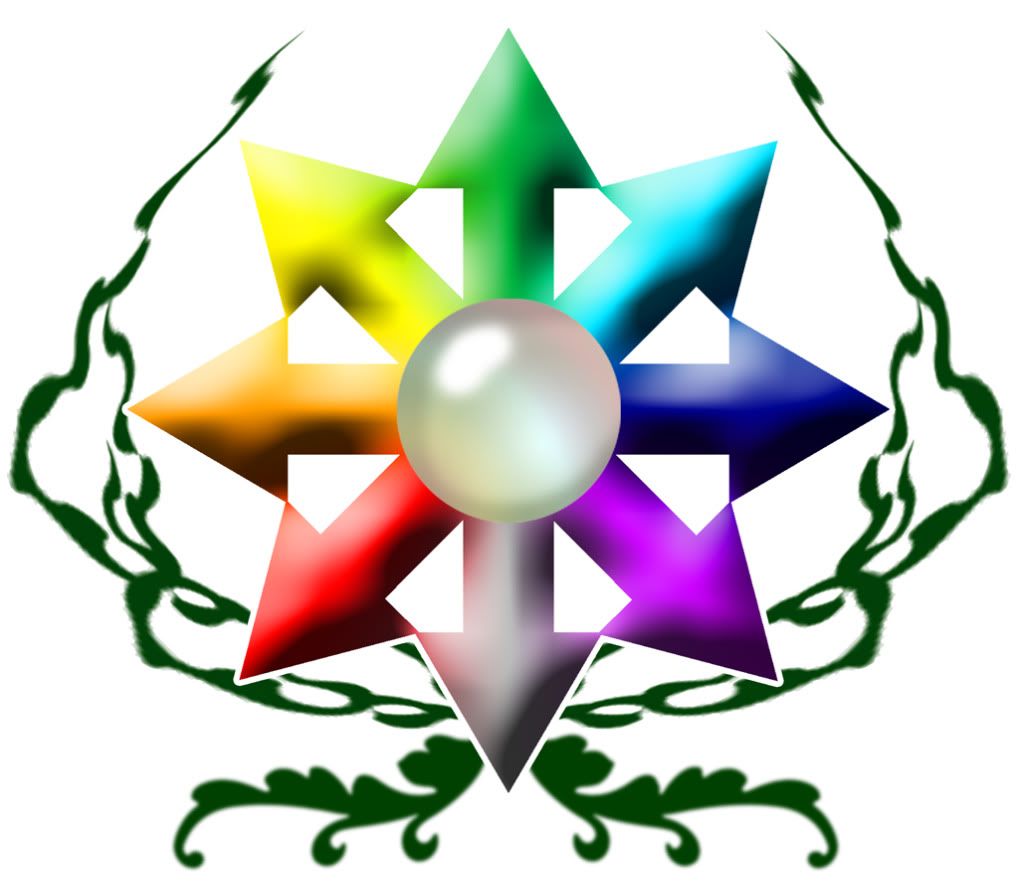
Banner of the Free Olympiad -- The flag flown at the games is the eight arrowed star.  The expanding arrows represent the freedom to move in any direction, while the spectrum of colors represents the individual's right to live as they see fit.  At the center is the pearl, a symbol of wisdom from which freedom is born.  It is ringed by a kelp wreath, all superimposed over a field of white.

Logo for the Free Olympiad
Logo for the Free Olympiad of the Known World
The Games

The Olympiad is a week long event that is held in the Zenith year of each calendar Age.  The games are hosted in turn by one of the four homeseas of the Periphery.  Though the races of the Hinterlands eventually were allowed to compete after lengthy and emotional petitioning, they have yet to be allowed to host an Olympiad.

Every city, from village to metropolis, is allowed entry of one contestant per game.

Stadion -- This is the basic game from which all other competitions grew from.  Originally the "gladiator" was thrown into the arena with a predator and the Kraken watched sadistically as he swam for is life.  Now, the stadion is a short sprint across the stadium.
Diaulous -- A more extensive version of the stadion, the diaulous is a lap around the border of the stadium.  This race has a variant where a baton is passed off to a new runner at the completion of each lap.
Marathon -- Meant as a test of endurance, the marathon consists of eight to sixty-four laps around the stadium.  More progressive organizers have begun to schedule these races outside of arena, across open sea floor, along a pre-determined path with checkpoints at strategic places that must be reached in a specific order.
Wrestling -- A physical test, where two combatants must pin the opponent in one of several classical methods.  It is more a testament to skill than an show of force.
Pankration -- A throwback to the brutal origins of the Olympiad, this bare-handed combat does not end until the opponent submits.  Due to the programs of patriotic propaganda many contestants are inundated by, a long line of athletes have refused to submit when clearly outmatched.  The list of the dead dragged from the arena are both a shameful waste and a tragic reminder of the Olympiad's origins.
Unguis Fighting -- This is essentially a fencing match with thin, flexible javelins with blunted tips.  The game is graded on control of the ungues to strike precisely at vital spots.
Synchronized Swimming -- A tandem sport where complex acrobatics are married to the graceful movement of swimming.
Weightlifting -- Weightlifting in an aquatic environment is more difficult than the simple motion of picking something up.  It is the balancing of an items buoyancy, the ability to keep the weights from rising as well of sinking.  Two bars are used, both identical except for having absolutely diametrically opposite buoyancy -- one positive, the other negative.  The two bars are connect by a pair of fragile cords that break easily if pulled in opposite directions.  The athlete must keep the two bars within the length of these cords, and will be disqualified if either cord breaks.
Controversy

Despite their lofty intention, the Olympiad has been mired in controversy for as long as it has existed.  The earliest of these controversies is the charge that the mere existence of the Olympiad is a validation of the atrocities levied on the helpless populace during the Occupation.  Some charge that by continuing this barbaric ritual the piscean species are no better than their conquerors.

The games were also charged with racism.  While the Chelon that organize the Olympiad had little problem with this accusation, there was massive backlash for ages that the exclusion of the primitive races were barred entry into the games.  Supporters of the exclusion cited the general belief of Kouton collusion with the Kraken as reason enough for their exile, but the other side argued that if Locanth, Sahaguin, and Yaun-Teel gave their lives for the freedom of all the piscean races, then they should have the right to participate.  Eventually a compromise was reached, with the all primitive races -- including the Kouton -- allowed to join the games.  However, to this day, the Ceph are still excluded, with the usual rhetoric that they lacked the piscean form and thus were not equals.

The death of many contestants has become yet another contentious point against the continuation of the games.  The core of this argument stems from traditional patriotism versus morality.

Perhaps the most controversial aspects of the games is the recent movement to separate the species.  Historically, certain races have dominated particular games.  The swimming games have been locked by the Locanth since they were finally allowed to compete, and the Orcan have won the strength based games to the exclusion of all other races since the games began.  One side argues that even the fittest athlete cannot compete against a species that has evolved to excel at something they themselves did not evolve.  The other counters with the tenants of the Fluid Nations Accord, that all pisceans are created equal, and as equals should not be segregated.

"The Olympiad is a monument to all competition, not just for the winning.
It honors through its glorification the sacrifice of every individual that gave
their life to free us all from our subjugators, not just those that survived the war."

-- Opening commencements of the first Free Olympiad

Tuesday, September 14, 2010

Endless Blue - Week 37.7 - Muses of the Five Senses

Sociology

Muses of the Five Senses

As long as pisceans have lived, they have felt the need to express themselves, to share a part of themselves, their beliefs, their understanding, with the rest of the school.  Words, not always adequate in themselves or the individual's mastery of them, are replaced with innovative ways, communicating through other senses what seems impossible by speech.  By nature, muse is subjective, dependent on the skill of the artist to produce, the readiness of the patron to accept ideas, and the social expectation of how the individual should behave.

Art -- Muse of Sight

Art in the Endless Blue is an extension of fabrication.  It is the need to create something solid through a physical medium.  The earliest pieces of art were scrimshaw carvings in flotsam or coral.  As the level of technology increased, art expressed itself in newer mediums, such as through architecture, sculpture, and painting.   Painting through water is a difficult task, and requires specialized pigment that are pliable enough to manipulate with relative ease but resist the environment's constant solvency to wash it away.  The creation of a waxy pigment led to the birth painting, and the pinnacle tool of the trade exists in the form of the greasemarker.  The cultivation of animals led to the use of canvases made of hide, the expression of fashion through the wearing of iridescent scales and mined precious metals.  Packbreeders took wild species of aquatic spider and sea worms that produce small amounts of silk and bred them into textile marvels, just as they grew the oyster and the abalone into giants for their opalescent treasures.  Anything that is made by the hands of a craftsman can be utilized as the basis of art.
Music -- Muse of Sound

Music is as integral part of piscean life as any other artistic expression, and in a world wrapped in water music takes on a life of its own.  The acoustic properties of water are perfect for propagating the reverberating sound waves produced by musical instruments, but require more energy to initiate their tones.  Water carries sound further because it is a denser material, thus can impart the vibration faster than the thinner medium of air.  This means any instrument that can be developed can have an aquatic counterpart.  The musical instruments of Elqua can be broken down into five categories:
Cordostrings -- Instruments that make sound through vibrating a stretched string.  Examples are the violin or lute.
Hydrocurrents -- These instruments produce sound by blowing a column of water through an echoing chamber.  The flute or the common horn are examples.
Idiopercussions -- Represented by a child's rattle, a cymbal, or the xylophone, these instruments elicit sound by striking, scraping, or shaking.  The notes produced are short, and cannot produce extended notes.
Membranedrums -- Similar to idiopercussions in that the need to be struck to produce their notes, these instruments are stretched membranes over a hollow space that serves as a reverberation chamber.
Vocalsong -- The piscean voice, regarded as the most versatile and pliant instrument.  The Orcan versesingers are renown for the haunting beauty of their whalesong.
Through combination of some or all of these types of musical instruments, the waters of the Known World vibrate wonderfully with music.  And in response, somewhere deep within the piscean psyche, is the impetus to dance.  It is the audience's reflection of the expression, the language of agreement, that conveys a deep resonance to the music.
Food -- Muse of Taste

If there is one activity that is common to all the races of the Endless Blue, it would be the need to eat.  Survival, be it as an individual or as a species, is critically dependent on the consumption of nutrients to maintain health.  Without food, there is no energy; without energy, there can be no life.
Culinists are the artisans of this muse, crafting works of culinary magnificence to delight even the most jaded of palette.  They do so by manipulating the taste buds with sensations that can be divided into five categories:
Bitterness -- Classically defined as an unpleasant sensation, the sensitivity to bitterness evolved as a method to detect toxic substances before they are swallowed.  It is best used in small doses to accentuate the taste of a dish.
Saltiness -- This is the well known taste of seawater.  Since every gulp of breath brings the same taste, salt as a spice is usually rare.  It does come into play as a preservative of meat in the process of jerking.
Savoriness -- Savory flavors are those of meat, a heady sensation released during mastication.  Some culinists say that herbivores lack the ability to sense this flavour, which has prevented their evolutionary ascendancy.
Sourness -- Considered the opposite of sweetness, sourness developed as a method of plants and animals to avoid being eaten.  However, in small amounts it can be an interesting counterbalance to a light meal.
Sweetness -- The taste of suger, the food produced internally by plants.  It is the basic source of energy used by not only piscean biology, but most every form of life on the planet.
Sex -- Muse of Touch

Next to the need to feed, the need to breed is nearly universal.  Nature has very cleverly bred the need to spawn into the very flesh of life, under the principle that the more offspring produced betters the chance of one surviving to reproduce itself.
Many of the religions of Elqua, notably the Olyhydrans, use dogma to shame its constituents, twisting their minds to believe that sex is a sin, a horrible temptation that needs to be resisted.  Sex is only sanctioned in the case of matrimony, and then only for the sake of procreation.  By instilling a moral taboo on a natural process, the churches have used their parishioners own guilt to sheperd them into the flock.  Their own guilt tells them they are unworthy of grace, and the church offers them absolution if only they ask for it.
More primitive spiritual systems, like those of the Locanth and the Yaun-Teel, embrace sex as a natural part of being piscean, of being alive.  In these cultures, sex is viewed as any other social activity, bereft of shame.  While the Yaun-Teel revel in their hedonism, the primitives like the Locanth, Kouton, and Sahaguin simply view it as another facet of life.
Between the two extremes fall the rest of the civilized races, trapped between the social taboo of lust and the undeniable yearning to fulfill it.  In these societies, the profession of prostitution has blossomed as a solution for the moral dilemma.
Thought -- Muse of Understanding

A new muse, many traditionalist refuse to accredit its validity.  To simply think is hardly an expression, they say.  But to the imaginative, the inquisitive, the investigative, the need to understand is as fulfilling as any other sense.  They would tell you that that the need to understand is the impetus of all the other muses, for they all seek to open the mind to sensation.  The openness of thought this philosophy espouses is tantalizing for the likes of the Godless, and as a result they flock to it.  But the movement has garnered strong opposition from those that benefit from rote tradition, whom see this dangerous thinking as the beginnings of dissension.

Friday, July 23, 2010

Endless Blue - Week 30 - The Ambusher, Guerilla Fighters of the Sargasso

Sociology


Ambusher
-- Guerilla Fighters of the Sargasso

Some careers come fully formed out of sheer skill, while others are pure need.  Ambushers are a mix of both -- the desperate need to survive in a world utterly turned against them coupled with such raw potential honed to a perfect result.  No other class is so well suited to take advantage of their natural abilities to hide amongst the swaying foliage, only to suddenly turn around and become such a dangerous threat to unsuspecting prey.  Nothing is safe in the cool blue waters of Elqua, not when a whirling dervish of pain could erupt from any direction without so much as a ripple.

Adventurers: Minimalists are drawn to the ambusher's lifestyle, with few belongings to weigh them down.  The freedom from the metaphorical shackles of possessions gives them liberty few have ever truly known.  One part wanderlust, one part survivalist, and one part individualist, ambushers took their persecuted circumstances and remade themselves into testaments of resilience.

Alignment: Most ambushers are chaotic neutral, hoping on optical deception and quiet patience to guard them from danger but relying on quick reaction and random savagery to escape from the direst of situations.  The constant pressure of life on the run that served as the impetus for the ambusher lifestyle left little opportunity for long term planning or rigid, inflexible thinking.  Everything could, and often did, change at a moment's notice, and an ambusher must be able to react instinctively.

Ambushers in the Known World
After the fall of the Kraken Empire and the Known World's freedom from occupation, the degenerating kraken were hunted ruthlessly where ever they tried to hide.  These cleansing witch hunts ran rampant across the Maw, scattering the bewildered and abandoned overlords across the bodies of water. As the years went by and their own bodies mutated into the puny forms that we know today as the Ceph, they were forced to rely on their brute strength and physiognomy to survive.

Hiding among the kelp forests, employing their camouflage abilities to stay hidden most of the time, springing out to attack the isolated straggler or wandering monster, the ceph ambushers had to make every attack quick and every attack had to count.  Much of the current irrational fear of the Ruins of the Kraken Empire stems from the hide-and-strike tactics used by the near feral ceph in order to survive.  They appeared suddenly, as if through magic, only to disappear again in the blink of an eye.  Few ever survived these ambushers, and many who did still were not sure of what happened to them.

GAME RULE INFORMATION

Ambushers have the following game statistics.

Abilities:
Strength is the primary focus for an ambusher, allowing him to strike more accurately and then cause more damage.  Behind that would come Constitution for the raw, primal vitality of health a high Constitution entails, and then Dexterity for the boost in stealth.

Race:
Only the lowly Ceph can become ambushers, as the class is practically a physical extension of their already existing potentiality.  Not even the Lumulans, with their vestigial extra arms, can achieve the manual dexterity or the astounding reach needed for multi-tentacled combat.

Alignment:
Any non-lawful, though most are more concerned about simple survival than any existential debate over good vs. evil.  Ambushers have more in common with animals trying to survive another day than existential thinkers trying to rationalize their world view.
Hit Dice:
d6.
Starting Funds:
2d4x5gp.

CLASS SKILLS

The ambusher's class skills (and key ability for each) are Climb (Str), Disguise (Cha), Hide (Dex), Intimidate (Cha), Move Silently (Dex), Sense Motive (Wis), Spot (Wis), and Survival (Wis).

Skill Points at 1st Level:
(2 + Int modifier) x 4.
Skill Points at Each Additional Level:
4 + Int modifier

CLASS FEATURES

All of the following are the ambusher's class features.

Ambusher Class Abilities Chart

Level BAB Fort Ref Will Feats Extra Attacks
1 +1 +0 +0 +0
Unarmed Strike, Two-Armed Fighting
0/1
2
+2 +0 +0 +0
Weapon Focus (Unarmed Strike)

3 +3 +1 +1 +1
Improved Unarmed Strike

4 +4 +1 +1 +1
Weapon Specialization(Unarmed Strike)

5 +5 +1 +1 +1
Flurry of Blow

6 +6/+1 +2 +2 +2
Multiattack
1/1
7 +7/+2 +2 +2 +2
Weapon Focus (Grapple)

8 +8/+3 +2 +2 +2
Four-Armed Fighting
1/2
9 +9/+4 +3 +3 +3
Weapon Specialization (Grapple)

10 +10/+5 +3 +3 +3
Ultra-camouflage

11 +11/+6/+1 +3 +3 +3
Improved Multiattack
2/2
12 +12/+7/+2 +4 +4 +4

13 +13/+8/+3 +4 +4 +4
Six-Armed Fighting
2/3
14 +14/+9/+4 +4 +4 +4

15 +15/+10/+5 +5 +5 +5

16 +16/+11/+6/+1 +5 +5 +5
Supreme Multiattack
3/3
17 +17/+12/+7/+2 +5 +5 +5

18 +18/+13/+8/+3 +6 +6 +6
Eight-Armed Fighting
3/4
19 +19/+14/+9/+4 +6 +6 +6

20 +20/+15/+10/+5 +6 +6 +6


Weapons and Armor Proficiencies:
Ambushers are proficient in all simple weapons and may wear any light armor.  Most of the classes' abilities are contingent on using unarmed attacks and therefore require empty "hands".

Hands vs. Tentacles
While it is easy to see that the Ceph have what we could equate with arms, they are lacking any obvious source of minute manipulation like other pisceans have evolved in the form of hands.  The ceph tentacle has its root at the base of the creature's body, extending about the length of a piscean arm (the actual length varies according to which of the three genotypes is in question, with the "cuttlefish" having the shortest arms and the "squid" having the longest) and tapers off to the tip.  Two of these eight tentacles end in a broad pad, and these serves as their hand, folding in half and wrapping around the item to be held.  These are their primary limbs, the equivalent to any other races arms, and it is with these arms that the fine, dexterous movements like writing are made.  Ceph still, like all other intelligent races, favor one arm over another.
Subsequent arms, with enough skill, can be used to wield items as well, but without the widened musculature at the tip they are only capable of wrapping primitively around an item.  Carrying delicate things or items that need to be kept stable requires either a Balance check or a raw Dexterity check to prevent them from becoming damaged (apply their Strength modifier as damage).  The use of the Multiattack feat or the Ambusher class features remove this drawback at a rate of one pair of tentacles with every application of the feat/class feature.
Unarmed Strike: Ambushers develop styles that allow them to cause extreme damage with every blow, or to minimize that damage so it can be shrugged off in a matter of hours.  At will, they can choose whether their unarmed blows cause lethal or subdual damage, with no penalty to attack or damage rolls.  They are still limited in dealing damage by the creature type being targetted, and cannot for example cause subdual damage to undead or constructs.

Two-Armed Fighting: An ambusher can fight unarmed with both arms, granting an additional attack each round with the off-hand arm at the standard penalty for off-hand attacks.  Treat this class ability like the Two-Weapon Fighting feat that only applies to unarmed strikes, resulting in -2 penalty for primary hand attacks and a -2 penalty for off-hand attacks.  This means an off-hand unarmed attack will always have the same bonus as the corresponding primary hand attack.  However, damage from successful attacks with the off hand arm only benefit from half of the ambusher's Strength modifier, rounded down.

Weapon Focus (Unarmed Strike): As the feat Weapon Focus, the ambusher gains a +1 bonus on all unarmed attack rolls.

Improved Unarmed Strike: Ambushers become adept in all manners of unarmed combat.  They are able to use their empty arms as weapons, whipping and lashing at a target rapidly, and do not invoke an attack of opportunity when attacking unarmed.  This ability applies only to their unarmed attacks, and does not extend to any other weapons they employ, even monk weapons or attempts at grappling.

Weapon Specialization (Unarmed Strike): By 4th level, the ambusher is so adroit at attacking unarmed that he gains a +2 bonus on all damage rolls when attacking unarmed.  Ambushers are allowed to continue along the Weapon Focus/Specialization tree using feats gained at every three character levels (by taking Greater Weapon Focus and Greater Weapon Specialization) as if they were fighters, but must still meet all other prerequisites.

Flurry of Blows: Similar to the Monk class ability, ambushers gain the skill to make a massive number of attacks at the cost of accuracy.  Upon reaching 5th level, when using the flurry of blows ability, all attacks that round suffer a -2 penalty (including off hand attacks) but gain an additional attack with their primary arm at their highest base attack bonus.  This penalty lasts for a whole round, until the ambusher's action the next round.  If the ambusher is allowed an attack of opportunity before that new round, it suffers the -2 penalty as well.  Unlike the Monk class ability, an ambusher's flurry of blows penalty does not alter as he gains levels in the class.  An ambusher may not make grapple attempts while using the flurry of blows class feature.

Mulitiattack: At 6th level an ambushers gain the ability to employ an additional pair of arms in combat.  This grants one additional attack with the primary hand, at the highest base attack bonus.  While this allows the usage of additional shields, the shield bonuses of concurrently used shield do not stack -- instead they only serve to givesthe ambusher protection on additional sides (i.e., with two shields, the ambusher would gain the shield bonus from attacks made from the direction of attack that has the shield between himself and the attacker: front, left, right, rear, above, or below).  The shield bonus applies to any attacks coming from the nine cubes on the same plane that the shield is facing.
          Further, every shield being used reduces the number of available off-hand attacks by one, starting with the least favorable one.

Weapon Focus (Grapple): This ability is the same as the Weapon Focus feat, and gives the ambusher a +1 attack bonus when trying to perform the grapple special action.

Four-Armed Fighting: As with Two-Armed Fighting, but this class feature grants an ambusher the ability to utilize an additional pair of arms in combat.  This equates into an additional attack each round with the off-hand arm at the second highest base attack bonus.  The standard penalty for off-hand attacks (attack and damage rolls) still apply.

An ambusher with this ability may employ it with the grapple action, allowing him to grapple with two arms, then attack with two others (assuming the grapple was not initiated with his final iterative attack).  The ambusher will get a single attack with both a primary arm and his off-hand arm at his current base attack bonus.

Weapon Specialization (Grapple):
By 9th level, the ambusher's reflexes are so well honed in grappling that he gains a +2 bonus on all damage rolls when attempting a grapple.  This is essential identical to the Weapon Specialization feat.  Ambushers are allowed to continue along the Weapon Focus/Specialization tree using feats gained at every three character levels (by taking Greater Weapon Focus and Greater Weapon Specialization) as if they were fighters, but must still meet all other prerequisites.

Ultra-camouflage: At 10th level, an ambusher has mastered his natural camouflage ability through intense practice and enhanced via dietary techniques discovered during their years foraging in the Ruins to rely less on chemicals that fluoresce in ultraviolet light.  When an ambusher is in the area of ultraviolet light and utilizing their camouflage ability, observers with ultravision must make a Spot check at a DC of 15 + the ambusher's levels in the ambusher character class to hope to spot the hidden ceph.

Improved Multiattack:
An improved version of the Multiattack class feature that allows the use of an additional pair of arms.  The extra primary attack gained by this ability is at the second highest base attack bonus.  These ambushers can now use three shields at once, essentially improving their protection on three fronts but reducing the number of available off-hand attacks by one for each shield used (starting with the lowest bonus attack).

Six-Armed Fighting:
As with Four-Armed Fighting, an ambusher can fight unarmed with an additional pair of arms (now three pairs).  This grants an additional attack each round with the off-hand arm at the third highest base attack bonus.  The standard penalty for off-hand attacks (attack and damage rolls) still apply.
An ambusher with this ability may employ it with the grapple action, allowing him to grapple with two arms, then attack with four others (assuming the grapple was not initiated with either of his two final iterative attacks)..  The ambusher will get a two attacks with both a primary arm and his off-hand arm -- the first at his current base attack bonus and the second with a -5 penalty to the attack roll.  If the character does not have enough iterative attacks to make both primary and secondary attacks, he may make as many as he can until his allotment for this round is exhausted.

Supreme Multiattack: As the improved multiattack and multiattack class feature before it, this ability allows an ambusher the use of yet another pair of additional arms (for a total of 4 pairs of arms) at their third highest base attack bonus.  Shields can be employed in four of the six directions, but for each shield so used, reduce the number of available off-hand attacks by one (starting with the lowest bonus).

Eight-Armed Fighting: As with Two-Armed Fighting, but an ambusher can fight unarmed with an fourth pair of arms (for a total of four pairs).  This grants an additional attack each round with the off-hand arm at the fourth highest base attack bonus.  The standard penalty for off-hand attacks (attack and damage rolls) still apply.

An ambusher with this ability may employ it with the grapple action, allowing him to grapple with two arms, then attack with six others (assuming the grapple was not initiated with his one of the three final iterative attacks)..  The ambusher will get a three attacks with both a primary arm and his off-hand arm -- the first at his current base attack bonus, the second with a -5 penalty to the attack roll, and the third with a -10 penalty.  If the character does not have enough iterative attacks to make all three primary and secondary attacks, he may make as many as he can until his allotment for this round is exhausted.

Table of Ambusher's Additional Unarmed Attacks

Level Multiattack Tree
(Primary Arm only)
Both Arms (Multiattack + # Armed Fighting) Both Arms with Flurry of Blows
Primary Off-hand Primary Off-hand
1 +1 -1 -1 - -
2 +2 0 0 - -
3 +3 +1 +1 - -
4 +4 +2 +2 - -
5 +5 +3 +3 +1/+1 +1
6 +6/+6/+1 +4/+4/-1 +4 +2/+2/+2/-3 +2
7 +7/+7/+2 +5/+5/0 +5 +3/+3/+3/-2 +3
8 +8/+8/+3 +6/+6/+1 +6/+1 +4/+4/+4/-1 +4/-1
9 +9/+9/+4 +7/+7/+2 +7/+2 +5/+5/+5/0 +5/0
10 +10/+10/+5 +8/+8/+3 +8/+3 +6/+6/+6/+1 +6/+1
11 +11+11/+6/+6/+1 +9/+9/+4/+4/-1 +9/+4 +7/+7/+7/+2/+2/-3 +7/+2
12 +12/+12/+7/+7/+2 +10/+10/+5/+5/0 +10/+5 +8/+8/+8/+3/+3/-2 +8/+3
13 +13/+13/+8/+8/+3/+3 +11/+11/+6/+6/+1/+1 +11/+6/+1 +9/+9/+9/+4/+4/-1/-1 +9/+4/-1
14 +14/+14/+9/+9/+4/+4 +12/+12/+7/+7/+2/+2 +12/+7/+2 +10/+10/+10/+5/+5/0/0 +10/+5/0
15 +15/+15/+10/+10/+5/+5 +13/+13/+8/+8/+3/+3 +13/+8/+3 +11/+11/+11/+6/+6/+1/+1 +11/+6/+1
16 +16/+16/+11/+11/+6/+6/+1 +14/+14/+9/+9/+4/+4/-1 +14/+9/+4 +12/+12/+12/+7/+7/+2/+2/-3 +12/+7/+2
17 +17/+17/+12/+12/+7/+7/+2 +15/+15/+10/+10/+5/+5/0 +15/+10/+5 +13/+13/+13/+8/+8/+3/+3/-2 +13/+8/+3
18 +18/+18/+13/+13/+8/+8/+3 +16/+16/+11/+11/+6/+6/+1 +16/+11/+6/+1 +14/+14/+14/+9/+9/+4/+4/-1 +14/+9/+4/-1
19 +19/+19/+14/+14/+9/+9/+4 +17/+17/+12/+12/+7/+7/+2 +17+12/+7/+2 +15/+15/+15/+10/+10/+5/+5/0 +15/+10/+5/0
20 +20/+20/+15/+15/+10/+10/+5 +18/+18/+13/+13/+8/+8/+3 +18/+13/+8/+3 +16/+16/+16/+11/+11/+6/+6/+1 +16/+11/+6/+1
Note:  These numbers do not reflect bonuses given by Weapon Focus or Weapon Specialization class abilities/feats, nor those from a high Strength modifier.

"If not for our superior martial prowess, the sheer ability
of seasoned ceph ambushers to deliver such astonding damage
would leave me fearful of a second occupation…"
-- the accomplished Orcan packbreeder known as "The Beastmaster".