Friday, November 12, 2010

Endless Blue - Week 46 - Orbs of Krakenkind

Archeology

Orbs of Krakenkind

Particularly potent relics of a time when the Elder Squids hunted the waters of the Endless Blue, each Orb of Krakenkind is a sphere about one foot in diameter.  Its out layer has a thick, unyeilding texture, like slathered on shellac, that taints the viscous goo entrapped within its confines with a hue of molten amber.  Suspended in the tacky inner mucus is a free floating darkness, barely visible through the occluded sebaceous muck.  This suspended mass, untethered to the Orb's outer veneer, weighs heavily despite the surrounding ocean pressures.  This un-anchored center of gravity makes holding either sphere balanced a difficult task, and no matter what the depth it is taken to it will always pull downward with a negative buoyancy.


An unactivated Orb of Krakenkind
An Orb of Krakenkind when first discovered.
The whirling, swirling, twirling miasma of oily, waxy oozes has no perceptible pattern to its internal  flux, seeming to be an eternal current of featureless ichor and bile.  Only once its ancient powers are activated does the thick curtain of scum part and a huge iris, rippled with golden hues of color and tensed lengths of muscle.  Smack dab in the center of that constantly refocusing iris gapes the terrifying waved shape of a Kraken's pupil.  It stares directly out, its penetrating gaze constant in a single direct no matter which direction the Orb is turned.

Front view of an Orb of Kraken Kind
An Orb of Krakenkind once activated.
History

Evidence of the existence of any of the Orbs of Krakenkind is mostly supposition and vagaries, accumulated through the telling and retelling of mythical folklore.  True evidence of the primordial subsistence of such artifacts is generally cited as the work of fevered dreams or broken minds.

Despite eloquent theories and plausible rationalizations, there are in actuality only a single pair of Krakonic Orbs.  The matched pair of orbs forever point in opposite directions.  As one always gazes into the past and the other peers into the future, they can never look at each other.  Attempt to turn the first in the direction of its mate will cause the mate to move, much like magnets with the same polarity.  If the mate is constrained or has more force pushing on it to keep it from moving, the first cannot turn at all.  A very literal example of irresistible force meeting immovable object.

When in use, the iris of the eyes sheds a glow that matches the Era of history being viewed.  Only the Cardinal, Bronze, Golden, and Verdant/Verdigris eras can be scryed through the Krakonian Orb of Past and conversely only the Indigo, Violaceous, and Livid ages can be spied through the Krakonian Orb of Future.  Moments of the Cerulean Era ares split between the two eyes as is fitting the time the investigated incidents occurred.  Once activated, the pupil then dilates from the infamous w-shape into a round portal in which the time and place may be observed.

Historians assert one of the Orbs must have been used to prophesy the unification of the Kraken species and ascendancy into the occupying empire that dominated the Fluid Nations.  How else, they argue, could such a fickle, uncooperative race put aside their instinctive tendencies and put the needs of the whole over the interests of the one without direct evidence of beneficial results?  To see is to believe, and before the Kraken Empire held sway over the Known World no one would have foreseen their alliance.

Campaign Use


Relics that predict future events pose an incredible boon to those that can auger their messages, and seeking out such means of prognostication would be highly sought after.  The quest to find just one Orb of Krakenkind is but the start of a longer adventure, involving the unique properties of the Orbs to seek out its mate.  The eye that looks back through time can leave glimpses of the places where the other Orb once stood, or the eyes that spies forward may leave tantalizing hits of where the adventurers need to head next.  But even with just a single Krakonian Orb the possibilities unbounded by the limits of time.

Powers


Constant

- The pupils of either Orb will always point away from its partner's location.  At far distances the shift in direction the eye focuses is hard to gauge, but the closer the two come in proximity the greater the movement.  This is sort of a reverse compass, a load-stone effect pointing diametrically away from the object of desire.

Invoked

- Either Orb of Krakenkind can activate the following divination spells at will, but can only affect targets in periods of time appropriate for the particular eye: locate object, clairaudience/clairvoyance, scrying

- Either Orb of Krakenkind can activate the following divination spells oncer per day, but can only affect targets in periods of time appropriate for the particular eye: legend lore, divination, find the path

- Either Orb of Krakenkind can activate the following divination spells oncer per week, but can only affect targets in periods of time appropriate for the particular eye: discern location, foresight
Resonating
- The closer the two eyes come to each other, the clearer the prophecy that they reveal becomes.  To hold both eyes in either hand is believed to grant the bearer omniscience of history and future to the finest detail.
Curse
- The more the possessor indulges in the auguries of the Krakonian Orbs, the more malformed their minds become.  Slowly they lose their familiar personality quirks and stark taking on a distant, yet territorial mindset. Thought by though, the mind of the holder become more like that of a Kraken, driven by the same primordial urges of avarice and hunger that made the species feared across the seas of Elqua.  With both orbs in his possession, the holder begins a slow, horrifying metamorphosis, losing all connection with their piscean form and transmogrifying into a dread squid in both body and mind.  With this remaking of a lone individual into a massive Kraken, the Orbs complete their most insidious purpose -- the ressurection of the Kraken race.  The newly transformed Kraken's first impulse will be to sequester the orbs away in seperate but equally devious hiding places until the hubris of a new questor seeks out their terrible powers.
Suggested Means of Destruction

The eyes must be made to look at each other.
Both of the Orbs must be smashed at the exact moment as the other, while the act is replayed through its own dilated pupil.
The Orb must be hatched in the nursery of a non-extinct Kraken.

Friday, November 5, 2010

Endless Blue - Week 45 - Khantusk: Cetacean Symbol of Absolute Allegiance

Archeology

Khantusk: Cetacean Symbol of Absolute Allegiance

Khantusk is the jutting tooth from the long-deceased First Khan, pulled from its root during the battle with the Leviathan of Coinchenn.  As long as a mer's arm and just as thick, it would be an excessive large example of the tusk for even the biggest narwhal.  Its time-yellowed  ivory is stained a with a brown patina of weathered age that is emphasized by the pale engraving along its slightly upward curve that show lividly from the surrounding patina.  Shod near its root and tip with a band of lustrous black pearl, which anchor loosely wrapped, finely woven ribbons of velvet embroidered with text of silk thread.  The runic Aquelan symbols carved into the tusk that cite the militaristic violence committed during the First Khan's dynasty are swaddled by the calligraphic Verse sigils stitched into the wrap that recount the adulation of His loyal citizenry.  The artifact is far from pristine, with the stain of ancient blood on the ribbons, a cracked  bark-like texture, a fractured tip and a substantial divot missing from where the Leviathan ripped it from the First Khan's mouth.  Most notable is the weight of Khantusk.  First picked up, it is light, almost uplifting itself into the hands of a bearer; however as the mantle of leadership pulls down on the bearer, Khantusk weighs ever more heavily.

History

In the early ages of the Cetacean Barbarians, the disparate currents were united under a single leader.  Taking the title of Khan, this narwhal led the orcan tribes on a campaign of invasion and bloodshed that ensured their place in early Elquan history.  A campaign was begun, targeting the wayward Cetacean tribes across the Known World, invading the fledgling societies and cutting a swath of violence and atrocity across the Cetacean Oceans.  Pod after pod either pledged their absolute, undying allegiance to the Khan of the Cetacean Hordes, or were crushed by the Hordes masses.  Those that joined the Khan's cause were incorporated into the Hordes, dispersed among the Eight Banners so no one force was comprised too much of any one subjugated pod.

Eventually the unification of the Cetacean Oceans was not enough for the glory-seeking First Khan, and the turned is avaricious gaze towards the rest of the Known World.  His frenzied Hordes relentlessly raided the no mer's sea borders of the neighboring Chelon, Lumulus, and Mer homeseas.   Fear of impending incursion by their neighbors proved true, and the First Khan began a systematic invasion of territory that redefined the borders of the Fluid Nations.  Success after of ruthless success, victory after bloody victory, the dread of the Cetacean Hordes grew as their savagery and cruelty increased.

What could have been a new era in governance of the oceans of Elqua saw a change in timber, and the unshakable faith of the Orcans in their First Khan began to waver.  As dire and focused a military race they may be, even the combat centric civilization of the Horde began to balk at the First Khan's brutality.  No longer did the Khan demand fealty from the conquered, but subservience.  Those of his inner circle that worshiped him as divinity incarnate were no longer shown the attention of his charisma, but instead were treated as the warbeasts that were enslaved in the Horde's masses.  The First Khan's drive for perfection became obsession, and finally manifest in irresistible compulsion.  No where was the fall of the Khan's fame more clearly illustrated than the drive to dominate the Mer tribe known as the Dumasque.

The resistance of this one particular tribe of Mer, dwarfed in size and strength by the massively built Orcans, would have at an earlier time filled the minds and hearts of the Cetacean poet-warriors with pride.  Never before in their prehistory had they face so spirited an opponent, so unbreakable a species, as the Dumasque.  Combat is honor, and honor is life to the Orcans, and the conflict with the Dumasque exemplified that ideal.  But frustration mounted in the brow of the First Khan.  How dare these inferiors, these smaller pisceans, the inconsequential creatures stand in the way of His unification.  The more the Dumasque resisted, the more consumed with their defeat the Khan became.  His tactics grew more desperate, his methods more cruel.  He drew needed attention and resources from the rest of His dynasty to deal with this tiny obstacle.  Those among his Inner Circle that voiced simple concern, let alone opposition to the Khan's will, were ostracized to the front lines.  So single-minded was the Khan's obsession that once He finally expelled the Dumasque from their water, He did not rest his loyal-but-spent soldiers.  Instead, he vowed their obliteration from the seas of the world, and continued to chase the retreating survivors.  This advance history dubbed the Khan's Folly, as it took the dynasty's beleaguered and exhausted forces to their ultimate failure -- the Undertow.

The Khan's forces were decimated there, sucked down into the abyssal depths of Elqua by the Undertow by uncaring order of their warlord.  As the Dumasque, caught between the gyre of the Undertow and genocide by the ravening Khan, they chose destruction by the whirlpool.  The Khan would not accept this, and sent the Horde in after them.  The resultant chaos left barely a tenth of the Horde able to escape from the unrelenting swallowing of the Undertow, including most of the Khan's inner circle and his companion, the Rani.

As the broken Cetacean Barbarians dragged their shattered bodies back to their homesea, the Khan raved.  He railed against the universe, damned the gods for their pettiness, denying Him the victory that was due to him.  It was as the remnants passed through the shoals of Coinchenn that they fell prey to the Leviathan, a massive monstrosity that saw an easy meal in the bleeding, moaning survivors of the Undertow's wrath.  Unable to take another defeat, ruing His obsession and ashamed of the sacrifice made in his folly, the Khan threw himself at the Leviathan.  Crazed with guilt and shame and loathing, it is said the battle lasted for hours before the Leviathan maimed the Khan, pulling his tusk out from his jaw by the root.  By final decree, the Khan sent his forces back to their homesea as He dragged the monstrosity down to the Shelf and darkness.  Before their retreat, one of the bearers of the Eight Banners saved the Khan's tusk from sinking to the same end as the embattled combatants, and brought it home to the Oceans as a testimony to the end of the First Dynasty.

Returned to its place of birth, those that stayed behind and thus did not witness the descent of the First Khan into ruination, embraced the tusk as a monument to what had gone before.  They carved the military victories of their mightiest leader on the curved ivory, shackled to it the songs and praise of the people in silk.  Named "Khantusk", it became the mantle of power for the Cetacean Oceans, and was wielded by the subsequent Khans as they tried to recapture the glory that once bathed the Orcan hordes.  But never did the defeated Horde reclaimed the absolute allegiance of its people as it once enjoyed, and eventually the Orcan race left their barbaric ways behind to become one of the Civilized.

Here Khantusk languished in obscurity; once a mighty weapon, now little more than a forgotten symbol of an abandoned chapter in history, as reduced in import as the power of the Khan from which it came.  As the Orcans fostered their new role as diplomat between the races, Khantusk's importance was relegated to archivists and historians only.  It disappeared during one of the many outbreaks of the Shellback Wars at the end of the Golden Epoch, when one of the diplomatic missions of the Cetaceans between the two squabbling species went horribly awry and resulted in one of the most protracted skirmishes in Chelon/Lumulus relations before the emergence of the Kraken Empire.

Campaign Use

Khantusk would serve as a mighty tool for unifying nations, for bringing disparate forces together as a cohesive whole.  It would be of great import to any nation, be they expansionist or fending off the incursions of such a nation.  The players could be entrusted with retrieving the cetacean artifact, either from an invading warlord or for a homesea against said invader.  Or perhaps the player characters seek it out for themselves, to aid in their own ascension into the political powers of the Endless Blue.  Even the fact that the artifact is not whole can be a hook for adventure, with various parties of differing ethical and moral standing contesting over a shard of ivory that seems to have magical properties.

Powers

Continuous
- Infused with the decades of loyalty and fidelity, seeped with the patriotism that comes from utter nationalism, the very idea of Khantusk serves as a symbol for unity and leadership.  Those that posses the artifact are imbued with a portion of that First Khan's infamy.  If the bearer possess Khantusk for at least one month, their leadership potential is magnified by a magnitude of one.  Their masses of servants and soldiers swells, expanding from a crowd to an army.  Treat such a character as if they possessed the Leadership feat; and if such character already possess the leadership feat, multiply the results by 10.  Those with silver tongues and a skill for for attracting followers expands in the presence of Khantusk, potentially reaching into the thousands of dedicated supplicants.
- The bearer then begins to form an inner circle of loyalists, dedicated to both the Khantusk's bearer and his cause.  If the bearer has the Leadership feat, Khantusk's charismatic abilities multiplies the number of cohorts that flock to his cause.  The carrier gains a number of cohorts -- referred to as his inner circle -- equal to his normal Leadership result for 1st level followers.  These inner circle cohorts are still limited in experience by the class level limit listed for the bearer's Leadership score.  Members of the Inner Circle may themselves take the Leadership feat and gain their own followers and cohort, benefiting from a +2 association bonus.  However, once the bearer begins to suffer from the artifact's cursed power, that benefit becomes a -5 disadvantage due to the negative association.
- Finally, the bearer gains a companion.  One individual above all others understands the vision the bearer has for the nation and history, and shares in it with non-shakable loyalty.  This special cohort is the equal to the bearer, in level and influence, and will be seen by the bearers followers as the one true source for the bearer's wisdom.  The relationship between bearer and companion can be platonic or romantic, but whate ever the form it takes the pairing forges a primal, pure bond between the two free of jealousy or distrust.
Invoked
- When held, Khantusk can influence the attitude of others towards the bearer.  It can shift a non-player character's attitude positvely one stage (from hostile to unfriendly, then to indifferent, and so on).  This can only be done once a day per individual, but can influence any number of individuals.  Repeated daily use on the same individual(s) can cause strain on the bearer and may trigger the artifact's curse that much sooner.  If the individual targeted by Khantusk's influencing power is of the same race as the bearer, the adjustment in attitude leaps immediately to friendly status.
Cursed
- History repeats itself, and Khantusk ensures that those that bear its divine powers repeat the success and ultimate failure of the First Khan.  Slowly, over the length of the bearer's campaign, he will slowly begin to suffer from the same afflictions that the Unifier of the Cetacean Barbarians did: paranoia, megalomania, and narcissism.  His lust for blood and savagery in battle will take its toll, influencing the bearer's mind, making him cruel and primitive.
Suggested Means of Destruction

It must be replaced it in the remains of the First Khan's jaw.
It must be surrendered to the hands of a foe that has never opposed you.
It must be wrested from the bearer by their jaded companion and thrown to the disillusioned masses.

Friday, October 29, 2010

Endless Blue - Week 44 - The Ur'qwal'she: Perfection in Form

Archeology

The Ur'qwal'she

The Ur'qwal'she are a series of artifice construction projects that began secretly the Bronze Era of Elqua.  The current Ur'qwal'she -- the eight in the line of improved attempts at the perfect hippoideal form -- is almost ovoid in shape and about three meters radially.  An access lock on the outside of the oval casing is specifically designed for the triangular arrangement of the Lumulus' three fingers, which must interlock around the latch in order to open the hatch ingress.  Picking the lock is a nearly impossible task achieve without some form of divine intervention or arcane boon.

It becomes obvious upon opening the apparatus that this is not simply some dearthsteel shell.  Inside are strange pods, space for four masses roughly the size of pisceans.  These pods are interlaced with conduits, chains, ligaments, and cord, working into the very walls of the shell like fabric.  Inside the first two pods, at about the same location that a passenger's gill slits would be, are a series of ten sigil-less levers, and the bottom of these opened eggs lays a layer of padding around a central spool.

History

The inquisitive and the diplomatic have long tried to understand the minds of the incomprehensible Lumulus, and rarely has there been any success.  But the same is true from the Lumulan perspective looking outward at the homeseas of the shell-less.  Unshackled by the constraints of religious dogma, the alien minds of the Lumulus have contemplated tirelessly about the intrinsic metaphysical questions that the other races do.  It seems to be one of the few things shared in common with the rest of the piscean species, but even that commonality is not enough to catch glimpses into the inconceivable thought processes that ruminate in their chitinously encased craniums.  Without spiritual doctrine to dictate their direction, Lumulan philosophers turned to more logical methodology to glean the answers they sought.  In the quest to solve the enigma of why life exists, the Lumulus stepped into the role of Creator and chose to determine how.

The birth of the cultural quest known as  The Ur'qwal'she -- Perfection of Form -- began in the Bronze Era.  Developing the art of smithing metals not only gave the Lumulus an unsurpassable  edge in economical development, but gifted them with the medium in which to forge the most ambitious  agenda of any species in the known world.  The final objective of their progressive plan was to produce the perfect reproduction of the Lumulan morphology, and to attain that goal they began construction on a machine that would obsess their culture for millennia.  Individuals willing put aside their own aspirations for themselves, their families and their forgeclans, and instead targeted their attention on learning the skills and knowledge that would be needed to complete their great experiment.  The shaping of metal, the mixing of alchemicals, the assemblage of an almost never ending series of interconnecting clockwork parts was deemed more than an honor, but a duty more dear than loyalty to their race.

The beginning form of the Ur`qwal'she was simplistic, even austere.  A rough lozenge shape that could barely fit the two pilots elected to operate it during it's test trials.  Once cramped uncomfortably inside, the activation of the machine began a series of physical rearrangements of it's constituent pieces, like a revolving puzzle.  Three short, pole-like legs on each side, a pair of clumsy and cumbersome claws extended from the front, below the hemispherical portholes, each beneath a short but slim shaft of metal.  Behind it the rear extended in sections, lengthening the craft a half-times again before unfurling into a fluked rudder.  The deployed state corsely imitated the idealistic form of the crustacean-like shape of it creators.

Despite its auspicious beginnings, the inaugural launch of the Ur'qwal'she met in disaster.  Failure of the first incarnation was brutal and stunning, leading many to think the task was beyond the reach of Lumulan minds.  But in the end rugged determination won out and the project was renewed.  The second incarnation began reconstruction, cannibalizing the form of the first incarnation in much the same way a Lumulus might consume a previously shed carapace.  The Lumulus learned from their early mistake, improved upon the Perfect Form, and eventually were ready for their second attempt at creating perfection.

It failed.  So too did the next attempt, and the next, and the next after that...  Several generations of apparatus have been forged and re-forged, only to have nature prove the whole attempt to be in vain.  But each failure only further tempered the Lumulan resolve, and the pieces that were to become the artifact Ur'qwal'she were collected and started anew.

No incarnation of the Ur'qwal'she has ever been lost.  The closest came during an outbreak of the Shellback skirmishes when aggressive Chelon forces occupied the area secretly storing the apparatus' bare structure for several months.  During those few months it took every ounce of Lumulan ingenuity and dedication to finally drive back the invaders whom it is believed never found the hidden workshop that stored it.  Quickly the Lumulus moved it to a more remote location on the fringes of the Lumulus Basin and the Spine of the World, in the Antarctic Circle.  There it lay dormant and undiscovered as the Kraken Empire rose to prominence and dominated the Known World.

With the fall of the Kraken Empire, the way was cleared to rescue the Ur'qwal'she from banishment and continue the creation.  Today, the octal incarnation is near completion, in part due to the same "deal with the devil" the Lumulus made with the Chelon to defeat their common masters.  Now armed with the secret of lumulating dearthsteel, the Lumulus are convinced this is the ultimate achievement, and success is all but ensured.  Once activated, it will the culmination of a geas felt through the entire species for nearly as long as there is written record of history.

Campaign Use

The Ur'qwal'she is not a simple magical item to be given the players as payment for some undertaken task.  Indeed, only under the most dire of circumstances would a player character even be let near the artifact, let alone been given control over its function.  However, threats to the artifact's location or existence are prime opportunities for interaction with the players.  The potential power of the craft is another angle, and the player characters might be enlisted by a concerned faction that the Ur'qwal'she will be used as weapon of war, or even a blue print for further creations.  Such a mechanized navy would make the LMSDF or some other agency an unstoppable force, completely unbalancing the state of affairs among the Fluid Nations.

Powers

Constant
- Gazing through the porthole "eyes" of the Ur'qwal'shi grant those viewing with ultravision up to 60 feet.
- The claws possess the vorpal and keen weapon qualities.
Invoked
- The craft can ignore the effects of any current or buoyancy altering spell.
- The body of the vessel can be made to shed ultraviolet light equivalent to daylight so that those inside may see out the porthole "eyes".
- The apparatus virtually inhales in water like any other living creature, sustaining a breathable liquid for those inside.  It automatically filters out any toxic or poisonous substance carried in that inhaled water (such as Ceph ink, red tide toxin, or other contaminant), but does not provide breathable water where there is not (such as in a brine lake or above the surface).  This power prevents the passengers from using any type of currentsense within the confines of the craft.  The apparatus can seal off the flow of water from outside its hull and essentially "hold its breath", leaving the occupants to breathe enough stored fresh water for four to eight hours, divided evenly among the number of occupants.
Resonating
- The apparatus resonates with those parts of itself re-incorporated from previous incarnations.  As a result, the octal incarnation has a primitive "race memory" imprinted on its alchemical conduits and eldritch mechanisms.  This imparts upon the pilot of the vessel an almost empathic link with the craft, and passes on rudimentary emotional cues like fear and anger when face with conditions similar to those that destroyed it in previous incarnations.
- The artifact is capable of consuming prey caught in its pincers.  This act helps repair any physical damage to the craft first, then nourishes the passengers inside.  While inside, the passengers do not succumb to hunger or thirst.
Curse
- The rigors of using the Ur'qwal'she slowly drain the animus vitae of those inside.  The immediate effect is the doubling the need to trance (or sleep for non-Lumulus).  Long term exposure results in permanent point loss to Constitution, and eventually death.  Bodies left inside the Ur'qwal'she after death become perfectly mummified, preserved right down to the intact hair follicle.
Suggested Means of Destruction

It must be piloted to the surface and let all it vital fluids drain out onto the dry soil.
It must be crushed between two colliding islands that move.
It must be made to peel the hull from itself with its own pincers.

Friday, October 22, 2010

Endless Blue - Week 43 - The Art of Submerged War: Navies of the Known World

Sociology

The Art of Submerged War: Navies of the Known World

The Known World of Elqua may have a superficial resemblance to a placid paradise, but nothing could be further from the truth.  The Fluid Nations have been at war with one another for most of their history, and only recently as there been any relative peace between the powers.   The Cerulean Era is name such for the very fact that the Endless Blue had entered into a period of unprecedented peace if not prosperity.  But that idyllic time is coming to an end, as the homeseas have grown too large for their borders, having slowly settled outward into the treaty-enforced spaces between countries called no mer's seas.  Skirmishes have begun as swimming space dwindles and foraging territories shrink.  The voices of the growing populaces are loudly demanding more water, more space, more freedom, but there is no more un-proportioned water to be had without expanding outward into the influences of their neighbors.

Only the civilized races of the Periphery have a standing navy, or even the infrastructure to support one.  The Hinterseas of the Kouton Bay, Gulf of Locanth, Yaun-Teel Bights, and Sahaguin Lagoons seem to be easier prey, with their less sophisticated cultures and more primitive armament.  The Laws of Fluid Dynamics would tell a society quickly outgrowing its alloted space to follow the path of least resistance, to enact an expansionist campaign outward against their primitive but ruthless neighbors.  But there is also the lure of moving inward to the Core.  For those brave (or ignorant) enough to ignore the superstitious fear of the Ruins of the Kraken Empire in the Maw, there lies the ancient pearl of the Elquan oceans, the Creche of Civilization, unused, uncontrolled, just waiting for the ambitious and the powerful to claim it as their own.

The Endless Blue Navies


It is little surprise to learn that in the culture of the martial Orcans it is expected for all citizens to serve at least one term in the the Orcan Naval Force (ONF).  The ONF is a alliance of city-state militias that serve as local law enforcement as well as a military reserve.  As much a part of their culture as their training, soldiers in the ONF understand that they must work together for the greater benefit of the Orcan government.

To achieve this aim, the ONF operates under the same "Eight Banner System" as the Cetacean Barbarian hordes of their history.  The military force is based on the smallest unit, an 8 Orcan group called an arav.  Eight of these aravs forms a zuut (64 soldiers),  with eight zuuts making a minhan (512 soldiers), and finally eight minhans completed a tumen (4096 soldiers).  Any number of tumens formed an ordu, the mispronounciation of this being the origin of the word Horde.

Ranks -- Khan, Noyan, Boyan, Ongul.
The Chelon navy if formally referred to as Her/His Majesty's Royal Armada, or HMRS.  It is comprised of a number of legions overseen by tribunes, whom in turn report to the legate placed in charge of them by royal decree.  A legion is six cohortes, which in turn is broken into six centuries of 60 to 180 legionaires.  These centuries are divided into a number of ranks dependent on the current military objective, a designation that refers to the ordered arrangement of legionaires into lines.  Each line is the equivalent of a unit of soldiers.  A Senate of Legates oversees the direction and deployment of the legions.

Ranks -- Legate, Tribune, Pilus, Centurion, Legionaire
The Lumulus Maritime Self -Defense Force, or LMSDF, are a decentralized military organization that works in cells across the surviving forgeclans.  These cells are not secretive, but the organization of who reports to whom is so complicated to the non-Lumulus that it is impossible to trace back to where orders originate.  Any one unit of the LMSDF only knows the unit above (and below at higher ranks).  This protects the chain of command from infiltration, as well as the individual Lumulus as their knowledge is always limited.  This strange, seemingly limiting method of letting soldiers "know only what they need to know" has kept their military particularly insular, and is one of the major reasons that the fall of the Kraken Empire could be achieved.

Ranks -- Unknown
The Mer Currents maintains a force called the United Marine Command (UMC).  The UMC is a multi-layered organization that starts with the shoal.  A shoal consists of 6 soldiers with an attachment of 1 packbreeder.  The consistency of these shoals varies greatly, dependent on the combat specialty for which the shoal is intended.   Infantry based shoals would be warriors with a packbreeder controlling beasts of massive builds, while a reconnaissance shoal would consist of scouts and a packbreeder guiding highly swift creatures.  Special shoals comprised of spellcasters but are not common and are normally part of a special branch, either the arcane or medical corps.

From there 2 to 4 shoals form a School, and 2 to 4 schools form a Company.  These companies typically take on colorful names as a traditional method of instilling pride and belonging into its constituent soldiers.  Further up the chain of command, 4 to 8 companies forms a Flotilla. and 2 to 4 flotillas makes a Brigade.  A Division is a pair of brigades, and 2 to four division forms a Corps.  Beyond that is only the highest military leaders, with the entire Fleet under their purview.

Ranks -- Fleet Admiral, Admiral, Rear Admiral, Commodore, Captain, Commander, Lieutenant Commander, Lieutenant, Junior Lieutenant, Ensign.

The Yaun-Teel, like everything else in their culture, relegates the need to maintain an armed services to private mercenary companies.  It is a business to them, like anything else they do.  There is no such concept as "patriotic duty" for the Yaun-Teel.  Instead, it is fulfilled by the work ethic expressed by the soldiers of the mercenary company.  This does not mean no Yaun-Teel ever feels the need to step up and lay down his life for his country, but it does mean that each mercenary company works independently of each other.  Hundreds of such organizations exist in the Bights, selling their swords to the highest bidder when there are brief respites in the waging of war between nations.

Ranks -- Per mercenary charter.
The other three primitive races -- the Kouton, the Locanth, and the Sahaguin -- deal with war and invasion on the local level, with each settlement taking on the responsibility of keeping its constituents alive.  While their homeseas are recognized as sovereign nations, they possess little in the way of a central government to lead them.  For issue of tsunami-level importance, the races generally hold a meeting of the elders, those individuals with sway and the means to enact others.

Ranks -- Not applicable.
"War spares neither the brave nor the cowardly: The brave are killed to wage and the cowardly are killed by the brave."
-- Unknown

Friday, October 15, 2010

Endless Blue - Week 42 - Garment Couture: The Fashion Aesthetic

Sociology

Garment Couture: The Fashion Aesthetic

Elquan fashions favor the simple over the complex.  While craftsmen are more than capable of (and do) producing the most intricate of work, the tendency of water to obscure light and detail means such astounding detail is lost.  Clothing and jewelery with fine detailing can only be appreciated in the Shore areas, where light can most easily penetrate the water's natural absorption.  As a result, many refer to those that wear detailed clothing and finery as "wanting to be deep fish in the shallows", referring to the vain desire to appear imposing in one's small area of influence.

Textiles

Fabric is a well known technology beneath the waters of Elqua, with records of woven fabrics dating back to the Bronze Epoch.  While cloth of that time originally had only the natural coloration of the plant or animal material from which it was derived, eventually dyeing became possible with mated containers.

All cloth is made on machines called looms, a moving interleave of thread that meshes together to form a continuous plain of fabric.  Thread itself is an extension of the creation of rope, refined and reduced to a more manipulative state.  Thread is comprised of the fibers of plant matter and/or the hairs of hairy aquatic mammals*, spun around each other to form a contiguous length of string.  The thread is then loaded into the loom which forms a criss-crossing lattice of interwoven threads.  The product is cloth.
A variety of cloth (and supple leathers) are used in Elquan fashion.  Indeed, cloth weaving is not limited to just organic materials.  Lamé -- a fabric made with a metallic weft --  uses a thin metallic yarn that is wrapped in a metallic wire or ribbon.  So fine and skillfully spun is this mineral thread that is becomes nearly as ductile as cloth without loosing the luster of precious metal.

Hides and skins of sea fauna are also used in the fabrication of clothing as it is in the creation of nautiluses, but where the latter uses tanning methodology that produces stiffer material, the former concentrates on softening the skins.  Fish skin comes in a wide variety of natural coloration and scale composition, and these gradations are used by seamstresses to produce incredible works.

Articles of Clothing

Clothing is the shaping of fabric into objects that can be worn on the piscean body.  Not every species in the oceans is equipped to survive in varying temperatures, and as such sometimes need extra protection to shield them from the elements.  Over successive generations clothing has evolved from just being "shelter that is worn" into an expression of art, tradition, culture, and personality.

Cap-- This is a generic catch-all term for anything worn essentially on the top of the head.  They can be kept in place by any manner of means, be it a tight headband, pinning in the hair, or strapped under the chin, jaw, or ears.
Choker -- A choker is like a necklace, but instead of hanging loosely down from the neck and shoulders, it is more snugly around the throat (but not too tight as to constrict breathing or swallowing.  It can serve the same role as a belt and can be what keeps the chemise (below) in place, but is differentiated by the need to keep the weight demands low as to prevent choking.
Chemise-- A chemise is an article of clothing that covers the torso of a piscean.  They may be as form fitting or formless as desired, and they need not include sleeves -- but may have them at various lengths, also either tight against the arms or more loosely draped as taste dictates.  The creation of chemises always needs to keep in mind the location of the picean gills along the lower ribs, and must keep that area free of obstruction lest they endanger the wearer with strangulation.
Glove -- The piscean glove is a bit more complicated than the gloves of our world.  Most pisceans have varying lengths of webbing between their digits, and natural ungues at their tips.  While this stretch of skin aids in swimming, it makes tailoring gloves more difficult.  A slit is cut in the fabric of the gloves where each finger connects to the hand and is extended outward to the second or third knuckle.  A piece of cloth is then folded over and sewn into the hem of the slit, and the seem is reinforced with stiffer materials to keep the glove form fitting.
Belt --  A loop around the major axis of the piscean body, belts are perhaps the most varied of all the articles of clothing.  They can vary in ever conceivable way -- thickness, width, tightness, color, even the method of wear is exceedingly flexible.  While traditionally worn perpendicular to the central anteroposterior axis, belts can be jauntily skewed over the hip, across the chest like a bandoleer, or even interlocked like a harness.  They are the most functional part of Elquan dress and the most universally utilized in every way of life.
Ephod -- The ephod is the article of clothing that covers the main trunk of the tail.  Like the shirt, it can be as basic as a cloth hanging from the waist to as complicated a network of interwoven fibers enshrouding the tail.
Caudalet -- Much like the choker, a caudalet is worn around the end of the tail right before the tail fins spread out from the piscean form.  Also like a choker, a caudalet can be used as the connective part of the lower end of an ephod or to anchor tail flippers (see below).
Flipper -- The lower counterpart of the glove, flippers are pieces of clothing worn over the pelvic and/or tail fins.  They are usually made of sterner stuff than gloves, as they must endure the constant wear of continual swimming.
Accessories

Accessories are differentiated from clothing in that they are usually comprised of harder materials than fabric, usually metal.  This material would be uncomfortable, even detrimental to the wearer is used like cloth.  They are instead used to accentuate and supplement the garments worn by a piscean.  Common forms of accessories take the form of jewelery such as earrings, torcs, bracelets, and rings.  Elquan tailors have taken to incorporating jewelery into their garment designs, making buttons, clasps, and buckles decorative as well as functional.  Other materials used in Elquan jewelery is abalone, crystal, gemstone, sea shell, and perhaps the most pervasive accoutrement of all, pearl.

Fashion by Historical Culture

Culture enforces as much influence on fashion as whimsy does.  Areas of high ethnic concentration will contain greater numbers of  traditionalists, whom bring the "old ways" of dress with them.  Part of being accepted into a society is the adoption of their customs, and adopting the apparel of the local populace is the primary visual means of integration.

The Yaun-Teel maintain a practice among their orthodox members of keeping their bodies fully clothed as much as possible.  This sets them apart from their slaves, whom are usually divested of all clothing early on in a method meant to humiliate and break the will of their "indentured servants".
With their culture very much entrenched in the martial tradition, it is unsurprising to find that the Orcans in a martial fashion, incorporating nautiluses into a style of dress that expects the struggle for life and death to erupt at any moment.
In many ways, the amount and intricacy of clothing worn by the Chelon is an indication of their social standing, with the more powerful and affulent affording complex outfits that fly in the face of function.
The Ceph both eschew clothing and are rebuked by it.  Their non-piscean forms make many of the articles of clothing useless to them, which is just as well as it would interfere with their natural camouflage abilities.  Ceph clothing must be specially made for them, usually consisting of a huge glove with eight fingers on it, caps, and belts.
Locanth and Sahaguin, cultures diametrically opposite oceanographically as well as philosophically, strangely share a common aesthetic when it comes to clothing.  They will dress pragmatically, opting for clothing that is functional for an intended purpose.
The strange Lumulus connect their clothing directly to their chitinous exoskeletons, anchoring them with piercings in the hardened plates.  Their quizzical clothing incorporates the unique metals that their culture is renown for into a way of dress that is both clothing and jewelery simultaneously.
The Mer are the most mercurial when it comes to clothing, as they are a species fascinated by fashion.  Fads come and go across all of the Mer currents quicker than a Kouton hides a secret, and they take their inspiration from whatever aspect of the mode of dress from other cultures strikes their fancy.  What is chic one day is dull the next, and whatever little feature of culture that captured their attention at one moment could cause social expulsion by the time you learned of it.
Speaking of the Kouton, they prefer to wear loose fitting robes and cowls that cover most of the body, obliterating any distinguishing features that may betray knowledge to others.
"Clothes make the Mer, so long as other make the clothes..."
- a snide comment on the way Mer reputation for dress.
---
* -- Despite being referred to as "mammals", these animals do not require air to breathe.  Like the cetaceans and dolphinidae of the setting, aquatic mammals have gills and never developed the blow hole, nostrils, or any other form of in taking the atmosphere into their bodies.

Friday, October 8, 2010

Endless Blue - Week 41 - Alchemy: Mixing Concoctions Under Water

Chemistry

Alchemy -- Mixing Concoctions Under Water

The art of alchemy is a laborious process at best, with the need to balance proper proportions, equalize doses, and mix various solutions together under highly controlled conditions.  In an aquatic environment, the process becomes infinitely more complex as the very water of the surrounding environment constantly runs the risk of diluting any experiment.  The slightest taint of the pure ingredients by water that has been exhaled, expelled, or excreted could utterly invalidate the veracity of an experiment.  Conversely, alchemists play with substances that are dangerous, even lethal, to pisceans, and should some of these odorless, tasteless, sightless concoctions spill into widely spread currents a virtual mass slaughter could occur.

The first tool of the alchemist is the mated container.  This refers to the necks of the containers where the solutions may be poured in or out.  The body of the container could be stiff or supple, dependent on the need of the mixture, but it is the coupling shape of the necks that allow protected mixing.  It is based on simple invention of the Screw, which is credited to early Chelon philosopher Vitruvides of Naucratilus during the Golden Epoch.

The end of a container comes either as a male or female spout.  The male spout has an extended length that is slightly less than the outward circumference, around with a grooved thread has been carved; the female end has no such extension, but a mirrored pattern of groves is carved into its inner circumference.  The male end is insert into the female end and twisted in a clockwise fashion until the thread of the screw is fully embedded.

The coupling is made waterproof by the precision of the two screw threads and the use of a gasket placed flush in the female end.  This gasket is made of plant fiber or animal cartilage and cushions the inserted male end against the female end's spout.  The produces a waterproof yet temporary seal that allows the substance in one container to be drained into the other simply by tipping the conjoined containers.  Sometimes these containers are constructed out of animal bladders instead of rigid materials, allowing a greater level of control over the expulsion of fluids from one container into another, and aided in the refinement of the alchemical tools used today.

Vacuum Sealed

Early alchemists first created waterless containers by inducing a vacuum in a sealed container by utilizing of denser-than-water liquids is required.  A long, stiff container with a resealable spout is immersed in a dense fluid located at least thirty-three feet below sea level and allowed to fill.  Water from brine rivers and lakes are ideally suited for this process as they will pool naturally at the ocean floor, and have such a distinct difference in density with the water around them that the effect is magnified.  By inverting the orientation of the filled container -- the spout pointing downward and the body pointed towards the surface world -- a vacuum can be achieved by gravity.  Pulling the stiff container slowly upward but not out of the brine pool creates a vacuum at the apex inside the container because the tensile strength of the container prevents itself from being crushed by external water pressure pressing inward, but the heaviness of the brine liquid is pulled downward by gravity.  Such vacuums were poor and small in size, but as the practice continued innovation allowed for the development of better tools.  Today alchemists have developed pumps that attach to mated containers that will draw all the water out.

By expelling water from a container, chemicals that would otherwise be toxic or caustic can be contained and used by alchemist.  This led to the hydrometallurgical process that the homeseas of Elqua use to produce their precious metals.  This also allows the leeching of gasses and solids from compounds, accomplished by letting the waste product from chemical reactions rise to an upper mated container (for gasses) or drop to a lower mated container (for liquids/solids).

Light Where the Sun Cannot Reach

The most ubiquitous application of this technology is the bluelight.  Named so due to the color of the light given off by the intermix of two distinct compounds, bluelight is the de facto method of illumination beneath the water's surface.  By mixing the two components in equal amounts and vigorously shaking, the agitated medium produces enough light equal to a torch.  The chemical reaction is steady, producing a flicker-less light that flares quickly into existence and slowly fades out in about an hour.  Doubling the amount of the first compound extends the duration of light by 50%; doubling the second compound improves the luminosity by 50%.  The balance between duration and brightness has been finely tuned through trial and error, and while it is possible to just mix more of the two solutions together in one larger commixture, better results are attained in smaller controlled mixes.

More so before the invention of bluelight, packbreeders would raise bioluminescent animals as a form of lighting.  To this day the raising of siltfish used in mining operations still thrives.  Siltfish are specially bred tropical, beautifully patterned with bioluminescent cells, that are very sensitive to changes in temperature and clarity of the water.  They are prefered by miners for deep excavations where light is needed as well as some method to determine of the ambient waters are poisonous.  The siltfish normally glows an organic blueish-green, but the glow will slowly change to reddish-violet as toxins build up in the fish's systems.  Using the fish requires a little more effort than simply cracking and shaking a bluelight, but so long as the fish is fed and tended well it will continually shed its light as long as it lives.

Traditionalist and many religious practices still require the usage of bioluminscent algae as a light source, such as the patriotic and uplifting ceremony of the Everglow during the Free Olympiad.  Even races such as the sonal Orcans, with their echolocative senses, still rely on the usage of sight for most of their daily routine.

Mechanics

Another adaption of the natural ocean around them is the application of lubricant.  Hinges and other moving parts made of solid material weather poorly under constant submersion in saline.  To counteract this corrosion, alchemists hit on the idea of employing the mucus of  hagfish as a grease.   When threatened, hagfish exude a slime that expands in water into a gelatinous goo that clings to surfaces yet slides effortless against itself.  The makes for a prime grease, and many times is used to accentuates the gasket in mated containers.  It possess innate anti-microbial properties that makes its seals antiseptic as well as watertight.  The slime itself is inert, but should it get in the gill slits of a piscean it can cause choking and eventual death from asphyxiation as the chest cavity fills with the phlegm.

Hagfish slime has since been co-opted by Ressurectionists as a component in their golem-like ambulatory undead for both the ability to block infections as well as it natural lubricatory and cartlaginous properties.

Connectors

With the introduction of the mated connectors, ingenious inventors have produced a long line of ancillary tools and aids that take advantage of this connectivity.  All manner of piping, valves, and taps have been designed to assist the alchemist in his chemical concoctions.  However, there has yet to be any form of standardization in these tools, with the work of each craftsman being nearly unique to themselves.  Some prefer thicker theading on screws to allow faster attachment, while other tend to use thinner threads that require more turning that results in a firmer coupling.  Aperture diameter, thread slope, even the very material comprising the tools differ between each manufacturer.  As a result many alchemists have resorted to carrying a hodgepodge of screw adaptors lying about in the off chance two pieces of pipe differ in size, or are the same gender.  The finest alchemist set ups use vent-blown glass manufactured by the Lumulus, tempered for strength and clarity but chemically inert as not to interfere with the reactions being observed.

Friday, October 1, 2010

Endless Blue - Week 40 - The Resurrectionists: Tailors of the Fabric that is Flesh

Sociology

Resurrectionists -- Tailors of the Fabric that is Flesh

Purveyors of the dead, dealers in dark magicks.  These are what the populace would call necromancers, dabblers in the animation of corpses.  But those that seek knowledge of the dead prefer the more neutral title: Resurrectionists.  Despite the conjured image of twisted souls perverting the sanctity of departed love ones to serve out some abstract nefarious goal, the Resurrectionists actually employ their misunderstood art for the betterment of the water world as a whole.  One part caring healer of the sick, another part environmentally conscious recycler, and a final part questor for eternal life, the Resurrectionists see themselves as the answer to the Known Worlds current problems.

Anatomy of an Anatomist

The beginning of the Resurrectionist movement lay partially with the creation of the scientific method of medicine.  To better understand how to combat infirmity and impairment, a healer must understand the underlying principles of biology.  Resorting to battlefield chirurgy can only reveal so much, with the mangled flesh and expended lives strewn across the waters like so much chum.  What few specimens were not scavenged by wildlife or ravaged by saltwater were hardly the best material from which to learn the secrets of how the piscean body works.  They needed better cadavers to examine, fresher bodies to dissect, in order to delve into the mystery of biology.

They turned to the packbreeders of Elqua, asking for the bodies of their expired warbeasts for anatomical research.  In exchange, the Resurrectionists shared insights with the donors to better breed their stock.  This arrangement worked well for both parties, and the knowledge of biology was furthered by fathoms in a reconnaissance of discovery.  But just as the small window of opportunity on the battlefield were mined of all their secrets, so too did the dissection of fauna eventually peter out of insight.  The Resurrectionsists had to face the truth they wished to avoid -- they needed intact, practically fresh piscean bodies.

The integrity of the dead is sacrosanct in nearly all Elquan cultures, and the rites that must be observed to properly ensure the passing of the dead are strict.  Foremost among them is the taboo against desecrating the body.  All dead are to be weighted and consigned to the depths, to sink further and further into the darkness below to become one with the Source.  Even the other religions such as Olyhydranism and Pantheon worship still command their schools to send their dead to the center of the globe.  The mere thought that the body of a loved one would not be weighted and sunk, thus forever barred from returning to their Creator, horrifies the piscean races.  But this tradition of burial is essentially throwing away perfectly good research material to a Resurrectionist.  It was such a loss each and every time blind superstition overrides the potential medical discovery that the Resurrectionists made a desperate move...  They began to clandestinely pay for bodies.

It was a shameful but unavoidable decision.  It had to be done, and to this day the Resurrectionists pay the unscrupulous and nonspiritual to "rescue" weighted bodies for later experimentation.  Delivery of the bodies had to be in secret, with utter discretion and no questions asked.  So long as the body thieves kept quiet about their clientele, the Resurrectionists asked no questions of how or where the bodies were collected.  With this unspoken pact in place, it was not long before the grave robbers began to offer "dead contracts".  Targeted at the desperate and poor, dead contracts were a formal if illegal agreement that the signer would receive payment now, interest free until the day he dies; at which point, the body of the deceased then becomes the property of the signor.  This trafficking of yet-to-be-dead bodies has not gone unnoticed by the authorities, but they can do little about it when the victims are too afraid of the body thieves to come forward.

As this financial arrangement became more and more lucrative, the Resurrectionists improved their healing skills and began to make a name form themselves.  This led to the formation of the guild known as the College of Doctors, established as an organization that garnered the fame from their successful medicine that could never be achieved under the banner of the Resurrectionists.  The organization has grown, diversified, and spread across the Known World.  So large is the organization now that most have no clue of the group's less than ethical beginnings and newly inducted members see it as the idealistic philosophy that the Resurrectionists pretend to be.

Pragmatism vs. Atheism

There is a confusion in the minds of the less metropolitan that the Resurrectionists and the Godless are the same philosophical movement.  This is simply not true.  Granted, Resurrectionist  share much in common with their atheistic counterparts, but the two movements have sharp distinctions.  The Godless espouse that the gods are false, while the Resurrectionists assert that the dead have no need to be revered.  Resurrectionists believe that once the body dies, the animus vitae-- the force of life -- is gone and what is left behind is so much scale and bone.  Whether the force of life simply dissipates or moves on to join with a creator is only of ancillary concern to these animists.  In contrast, Godless do not believe there is a Source or any other creator that collects souls, but life is still precious for the simple fact that it is the only thing in the universe that fights entropy.

Resurrectionists are not evil, and do not view what they do as an abomination against nature.  They are pragmatic, rationalizing that the departed have left this world behind. With their mortal shell cast aside as useless, there is not moral ambiguity in others using it as a natural resource.  It is little different than the piscean use of aquatic flora and fauna as food -- there is not cruel intention in the consumption, just the natural balance of life taking succor from the waters around it.  They would no more blink an eye at using the remains of a piscean as a miner has digging ore from the seabed or a culinist harvesting seaweed from the kelp fields.  It is simply a matter of pragmatism, using what exists as the tools of survival.  Societal mores make their activities taboo, but ethically it is no more antithetical to life as cutting coral for construction of shelters.

The Dead that Swim Once More

Many secrets owe their discovery to the questionable endeavors of the Resurrectionists.  They have contributed to more medical innovation than all other physical arts combined, and those breakthroughs have brought results that would have been declared miracles in earlier ages.  Indeed, it is their study of nature that gave them the ultimate lore -- the ability to make the dead move.

This unique talent traces its origins back to the earliest piscean archeologists whom took a second look at the strange formations in the rock bed.  Once simply regarded as an odd form of pareidolia, it was these early proto-Resurrectionists that realized the stone were actually fossils, petrified remains of living creatures that swam the oceans of Elqua epochs in the past.  They began to excavate these stony bones with an obsessive determination that their kinds still suffers under to this day, collecting the parts, arranging them in various orders as they postulated skeletal arrangement and musculature.  With the advent of Seamus Lorwynn's theory of evolution, they postulated the biology of the past to have parallels in the past, and used the morphology of modern sea monsters as a guide to model the prehistoric creatures against.  Ligaments, muscles, organs, flesh...  all masterfully plotted out in the minds of these imaginative and intuitive individuals so clearly and concisely they could practically make them move as they had when they were alive.  One day, they actually accomplished it, and the first living dead, or golem, was created.

The undead that Resurrectionists animate have more in common with puppets than the unliving, and a distinction must be made between the unliving that Resurrectionists create and the undead that seep down from the Vastness.  The former are vile aberrations of life, fueled by some unquenchable fury to destroy the faintest trace of animus vitae.  The latter are mere animated slabs of meat, muscle tissue given inertia through memory.  These undead are in actuality golems made of flesh and bone, stone and scale.

The first golems were primitive things, made of fossilized bones and clay flesh, lashed together with seaweed and hide, enshrouding a tiny flicker of animus vitae.  They possessed no grace, no beauty -- they were as ugly in sight as they were in function.  Those primitive attempts at bringing to life what was lifeless were things of horror and revilement.  It is no wonder that even today the Resurrectionists must keep their natures hidden from the light of day.

As techniques were refined, the most common form of golem was and still is the homunculus.  Small approximations of the piscean form, they look more like marionettes that living flesh.  But they were the first of the living dead that were imbued with intelligence, albeit rudimentary.  From those lowly beginnings, the Resurrectionists sought greater and greater achievements in the art of reanimation, growing in size and breadth and reach with each passing year.  Word of their discoveries have come under scrutiny of local lords, even the racial governments have looked closely at the potential for "rejuvenating soldiers" that reanimation promises.  Images of highly skilled and utterly loyal Royal Medic Corps being assigned to the regiments of countries' navies, attending to any of the wounded that were beyond saving, applying their craft there on the battlefield.  The details of what those medics would actually be performing are usually glossed over, but it takes little imagination to realize the result would be the cannibalization of the terminally wounded into cobbled together yet functioning soldiers.  The admirals in charge cling to visions that the worst of such behavior would be relegated to the fallen warbeasts of their forces, and are willingly turning a blind eye to the repugnance of the truth.

And with the borders becoming ever so much more restrictive, the conscription of Resurrectionists into the territory wars may be nearer than anyone realizes.

The Paragon Cynosure

Practitioners of alchemy have their Philosopher's Stone; the faithful have their Holy Grails.  There is a equal ultimate achievement among the Resurtectionists, sought as zealously as the Grail and as greedily as the Stone.  This cynosure of all Resurrectionists is nothing less that the resurrection of an extinct species.  Not the paltry animation of golems, but the restoration of the animus vitae in a species that has long ago gone extinct.  Treatises through the generations have posited on what that would mean, ethically, morally, spiritually, but most modern practitioners of reanimation begrudgingly agree that the paragon cynosure, the ultimate expression of resurrection, is to bring back a dead intelligent race.  Nothing else fits the bill better than the mysterious and infamous Icht.

Friday, September 24, 2010

Endless Blue - Week 39 - The Free Olympiad

Sociology

The Free Olympiad

The spirit of competition, distilled in the phrase "Faster, Stronger, Freer", has inspired the races of the Endless Blue to great achievements of body, mind, and soul.  Nothing embodies the motto more completely than the physical challenge known as the Free Olympiad.

The Olympiad, ironically enough, had its roots in the Kraken Occupation.  The cruel invaders would take troublemakers and leaders -- individuals that had the potential to galvanize the subjected homseas into a rebellion -- and force them into arenas to fight for their lives.  Either against captured predators or other rabble-rousers, they were often subjected to heinous and humiliating shows of violence for the entertainment of the Squid.  The popularity of these fights grew as the years passed by, with slaves and slavers alike rooting for their favored to win.

After the Kraken fell from the grace of their alien gods and the shackles of Occupation were smashed, the arenas remained.  Those in the Periphery were sites of rebellion, when the most experienced of gladiators threw off their yokes and led their fellow slaves to freedom.  The immediate reactionary sentiment was to destroy them all, eradicate any and all relics of the dark chapter of Elquan history in an effort to banish the memories.

And many were.  Some of these buildings were razed in the mania that followed their liberation, but others served as the headquarters of further resistance.  Their utilization as infrastructure for the resistance was extended to post-freedom assistance.  Maintaining these places as the center of liberation transformed them from memorials of past torture into edifices of freedom.  They essentially became symbols of the freedom the sentient races strove to achieve.  So when that freedom was finally won, there was question of what to do with the remaining structures.

The Traditions

The Everglow -- The most well known ceremony of the Olympiad, the Everglow is a metaphorical tradition representing the unending will that perseveres in the face of oppression.  A series of couriers is sent on a circuitous route through the Known World carrying a culture of bio-luminescent plankton that has been kept vibrant since the years of the Occupation.  At the Olympiad site, the surviving plankton is added to a nutrient-rich loam that the tiny creatures will gorge on for the length of the games.  The container is open to the waters, and the fattened plankton disperse throughout the area, becoming a widely dispersed cloud of sparkling motes.
Athlete's Oath -- Every competitor in the Olympiad makes the same oath, a pledge that evolved from the same pledge members of the Resistance made to their cause.
"I, in the name of all the races, pledge that I shall do whatever I can to compete against our obstructors, obeying and protecting the rights which govern us all, committing myself  to a tasking without betrayal and without surrender, in the true spirit of freedom, for the glory of liberty and the honour of our people."
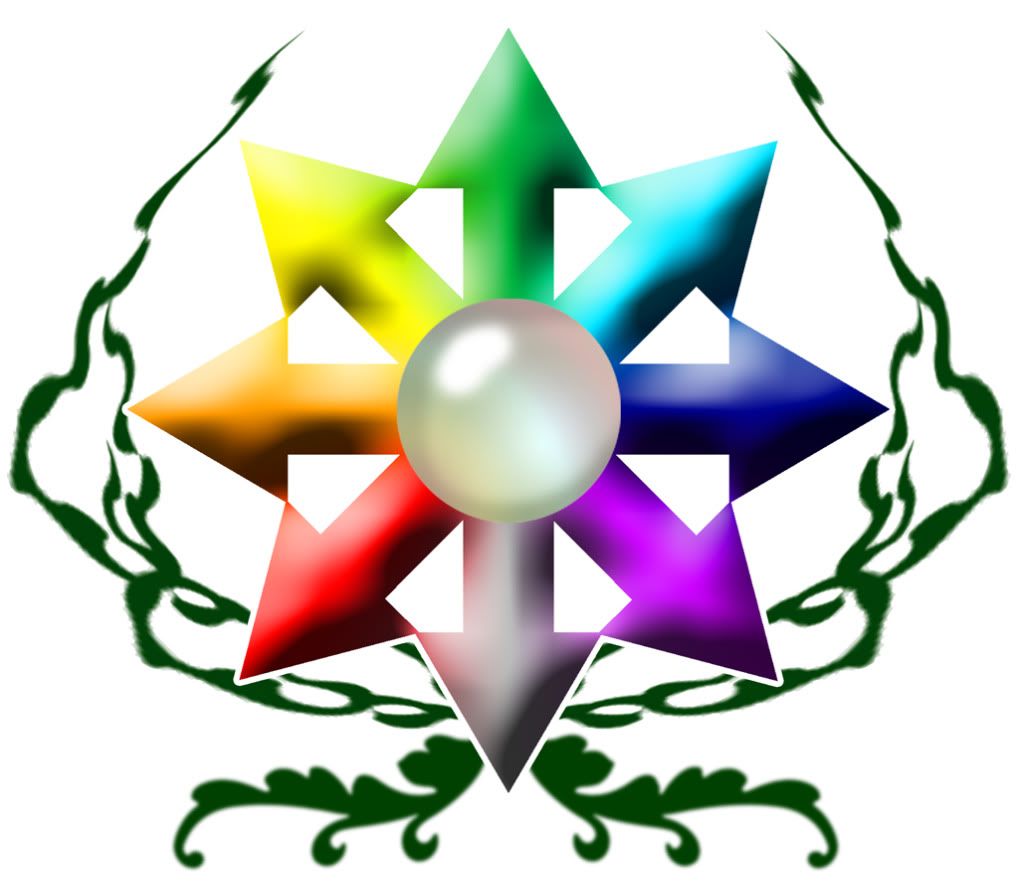
Banner of the Free Olympiad -- The flag flown at the games is the eight arrowed star.  The expanding arrows represent the freedom to move in any direction, while the spectrum of colors represents the individual's right to live as they see fit.  At the center is the pearl, a symbol of wisdom from which freedom is born.  It is ringed by a kelp wreath, all superimposed over a field of white.

Logo for the Free Olympiad
Logo for the Free Olympiad of the Known World
The Games

The Olympiad is a week long event that is held in the Zenith year of each calendar Age.  The games are hosted in turn by one of the four homeseas of the Periphery.  Though the races of the Hinterlands eventually were allowed to compete after lengthy and emotional petitioning, they have yet to be allowed to host an Olympiad.

Every city, from village to metropolis, is allowed entry of one contestant per game.

Stadion -- This is the basic game from which all other competitions grew from.  Originally the "gladiator" was thrown into the arena with a predator and the Kraken watched sadistically as he swam for is life.  Now, the stadion is a short sprint across the stadium.
Diaulous -- A more extensive version of the stadion, the diaulous is a lap around the border of the stadium.  This race has a variant where a baton is passed off to a new runner at the completion of each lap.
Marathon -- Meant as a test of endurance, the marathon consists of eight to sixty-four laps around the stadium.  More progressive organizers have begun to schedule these races outside of arena, across open sea floor, along a pre-determined path with checkpoints at strategic places that must be reached in a specific order.
Wrestling -- A physical test, where two combatants must pin the opponent in one of several classical methods.  It is more a testament to skill than an show of force.
Pankration -- A throwback to the brutal origins of the Olympiad, this bare-handed combat does not end until the opponent submits.  Due to the programs of patriotic propaganda many contestants are inundated by, a long line of athletes have refused to submit when clearly outmatched.  The list of the dead dragged from the arena are both a shameful waste and a tragic reminder of the Olympiad's origins.
Unguis Fighting -- This is essentially a fencing match with thin, flexible javelins with blunted tips.  The game is graded on control of the ungues to strike precisely at vital spots.
Synchronized Swimming -- A tandem sport where complex acrobatics are married to the graceful movement of swimming.
Weightlifting -- Weightlifting in an aquatic environment is more difficult than the simple motion of picking something up.  It is the balancing of an items buoyancy, the ability to keep the weights from rising as well of sinking.  Two bars are used, both identical except for having absolutely diametrically opposite buoyancy -- one positive, the other negative.  The two bars are connect by a pair of fragile cords that break easily if pulled in opposite directions.  The athlete must keep the two bars within the length of these cords, and will be disqualified if either cord breaks.
Controversy

Despite their lofty intention, the Olympiad has been mired in controversy for as long as it has existed.  The earliest of these controversies is the charge that the mere existence of the Olympiad is a validation of the atrocities levied on the helpless populace during the Occupation.  Some charge that by continuing this barbaric ritual the piscean species are no better than their conquerors.

The games were also charged with racism.  While the Chelon that organize the Olympiad had little problem with this accusation, there was massive backlash for ages that the exclusion of the primitive races were barred entry into the games.  Supporters of the exclusion cited the general belief of Kouton collusion with the Kraken as reason enough for their exile, but the other side argued that if Locanth, Sahaguin, and Yaun-Teel gave their lives for the freedom of all the piscean races, then they should have the right to participate.  Eventually a compromise was reached, with the all primitive races -- including the Kouton -- allowed to join the games.  However, to this day, the Ceph are still excluded, with the usual rhetoric that they lacked the piscean form and thus were not equals.

The death of many contestants has become yet another contentious point against the continuation of the games.  The core of this argument stems from traditional patriotism versus morality.

Perhaps the most controversial aspects of the games is the recent movement to separate the species.  Historically, certain races have dominated particular games.  The swimming games have been locked by the Locanth since they were finally allowed to compete, and the Orcan have won the strength based games to the exclusion of all other races since the games began.  One side argues that even the fittest athlete cannot compete against a species that has evolved to excel at something they themselves did not evolve.  The other counters with the tenants of the Fluid Nations Accord, that all pisceans are created equal, and as equals should not be segregated.

"The Olympiad is a monument to all competition, not just for the winning.
It honors through its glorification the sacrifice of every individual that gave
their life to free us all from our subjugators, not just those that survived the war."

-- Opening commencements of the first Free Olympiad

Friday, September 17, 2010

Endless Blue - Week 38 - Enchanted Items of the Endless Blue

Archaeology

Enchanted Items of the Endless Blue

Some items fit the seas of Elqua perfectly, while others would be anachronistic at best.  Items such as books and elixirs would never survive the ravages of constant immersion in saltwater.  Others, such as the decanter of endless water, make no sense where water is plentiful.

Nautiluses & Aegises

The following Special Abilities are suitable for the Endless Blue campaign setting:

Acid Resistance
Acid Resistance (Improved)
Acid Resistance (Greater)
Animated
Bashing -- Aegis only.
Blinding
Cold Resistance
Cold Resistance (Improved)
Cold Resistance (Greater)
Electricity Resistance
Electricity Resistance (Improved)
Electricity Resistance (Greater)
Fire Resistance -- Becomes Heat Resistance
Fire Resistance (Improved) -- Becomes Heat Resistance (Improved)
Fire Resistance (Greater) -- Becomes Heat Resistance (Greater)
Fortification
Ghost Touch
Glamored
Invulnerability
Reflecting
Shadow
Shadow (Improved)
Shadow (Greater)
Silent Moves
Silent Moves (Improved)
Silent Moves (Greater)
Slick
Slick (Improved)
Slick (Greater)
Sonic Resistance
Sonic Resistance (Improved)
Sonic Resistance (Greater)
Spell Resistance
Undead Controlling

The following Special Abilities for Nautiluses or Aegises are not suitable for the setting:

Arrow Catching
Arrow Deflection
Etherealness
Wild

The following specific armors exist, but the style of armor will be one compliant with the Endless Blue setting:

Banded Mail of Luck
Breastplate of Command
Full Plate of Speed

The following specific armors do not exist:

Celestial Armor
Demon Armor
Dragonhide Plate
-- Possibly may exist, composed of the treated remains of a Kraken, but most like myth or at best a single item.
Plate Armor of the Deep -- In a setting where everything breathes underwater, the usefulness of this nautilus is reduced.

The following specific aegises exist:

Caster's Shield
Lion's  Shield --  Replace the image of a Lion with that of a Shark.
Spined Shield

The following specific aegises do not exists:

Absorbing Shield
Winged Shield

Ungues

The following Special Abilities are suitable for the Endless Blue campaign setting:

Anarchic
Axiomatic
Bane
Brilliant Energy
Dancing
Defending
Disruption
Flaming -- Renamed Boiling, it sheathes the unques in boiling water and deals heat damage.
Flaming Burst -- Renamed Boiling Burst, it explodes with a burst of boiling water, causing additional heat damage.
Frost
Ghost Touch
Holy
Icy Burst
Keen
Ki Focus
Merciful
Mighty Cleaving
Shock -- Exists, but rarely used due to water's natural tendency to conduct electricity in unforeseeabledirections.
Shocking Burst -- Exists, but rarely used due to water's natural tendency to conduct electricity in unforeseeable directions.
Speed
Spell Storing
Thundering
Unholy
Vicious
Vorpal
Wounding

The following Special Abilities for Ungues are considered unsuitable for the setting:

Distance
Returning
Seeking
Throwing

The following specific ungues exist, but as setting appropriate weapons:

Assassin's Dagger
Dagger of Venom
Flame Tongue -- See Flaming above.  Causes heat damage.
Frost Brand
Holy Avenger
Life Drinker
Luck Blade
Mace of Smiting
Nine Lives Stealer
Rapier of Puncturing -- Can damage some creatures' ability to maintain their buoyancy.
Shatterspike -- Of particular use the rebellion against the Kraken Empire, whose tentacles can be sundered.
Sun Blade
Sword of Life Stealing
Sword of the Planes -- Does not posses the +4 ability.
Sword of Subtlety
Trident of Fish Command
Trident of Warning

The following specific ungues do not exist:

Dwarven Thrower
Mace of Terror
-- The ability is inconsistent with the purposes of a weapon.
Oathbow
Screaming Bolt
Slaying Arrow
Sleep Arrow
Sylvan Scimitar

Rings

The following Rings are suitable for the Endless Blue campaign setting:

Animal Friendship
Blinking
Chameleon Power -- Called Ceph Stealth, but otherwise identical.
Counterspells
Elemental Command -- Water elementals only.
Energy Resistance
Evasion
Feather Falling -- Called Buoyancy, it activates as per the original item any time the wearer's buoyancy changes from neutral.
Force Shield
Freedom of Movement
Friend Shield
Invisibility
Mind Shielding
Protection
Ram -- Renamed Porpoise, but otherwise the same.
Regeneration
Spell Storing (Minor)
Spell Storing
Spell Storing (Major)
Spell Turning
Telekinesis
Three Wishes
Wizardry
X-Ray Vision

The following Rings are deemed not suitable for the setting:

Climbing
Climbing (Improved)
Djinni Calling
Elemental Command
-- Anything other than water elementals.
Jumping
Jumping (Improved)
Shooting Stars
Sustenance
Swimming
Swimming (Improved)
Water Walking

Rods

The following Rods are suitable for the Endless Blue campaign setting:

Absorption
Alertness
Cancellation
Immovable
Lordly Might
Metal and Mineral Detection
Metamagic
Negation
Python -- Becomes a sea snake, otherwise same as original item.
Rulership
Splendor
Viper
Withering

The following Rods are seen as unsuitable for the setting:

Enemy Detection
Flailing
Flame Extinguishing
Security
Thunder and Lightning
Wonder

Staff

The following Staves are suitable for the Endless Blue campaign setting:

Abjuration
Charming
Conjuration -- No unseen servant ability.
Defense
Divination
Enchantment
Evocation
Fire -- Produces heat damage equivalents.
Frost
Healing
Illusion
Illumination
Life
Necromancy
Power
Size Alteration
Swarming Insects -- Summons aquatic vermin.
Transmutation -- No baleful polymorph ability
Woodlands -- Called Coral Reef

The following Staves do not exist in the Endless Blue setting:
Earth and Stone
Passage
Wondrous Items

The following Wondrous Items are suitable for the Endless Blue campaign setting:
Amulet of Health
Amulet of Mighty Fists
Amulet of Natural Armor
Amulet of Proof against Detection and Location
Bag of Tricks -- The ball inside feels slick to the touch, like fish scales.
Bead of Force
Belt (Monk's)
Belt of Giant Strength -- Called Belt of Behemoth's Strength
Boots of Elvenkind -- Called Flippers of Silence
Boots of Speed -- Called Flippers of Speed
Boots of Teleportation -- Called Flippers of Teleportation
Bowl of Commanding Water Elementals -- Reverse the effects for salt and fresh water.
Bracelet of Fiends
Bracers of Armor
Brooch of Shielding
Cape of the Mountebank
Chaos Diamond
Chime of Interruption
Chime of Opening
Circlet of Blasting (Minor)
Circlet of Blasting (Major)
Circlet of Persuasionz
Cloak of Charisma
Cloak of Displacement (Minor)
Cloak of Displacement (Major)
Cloak of Elvenkind -- Called Cloak of Silence
Cloak of the Manta Ray
Crystal Ball -- Rare items, made from the eyeballs of Kraken
Cube of Frost Resistence
Darkskull -- Size of skzull determines the size of unhallowness.
Drums of Panic
Dust of Dryness -- An alchemical capsule that when broken removes all water from an area.  Usually employed in small, sealed containers to extract elements and compounds for alchemy.
Dust of Tracelessness --  Another alchemical concoction that blocks currentsense when released into the current.
Elemental Gem -- Water elemental only.
Eyes of Charming
Eyes of Doom
Eyes of the Eagle -- Called Eyes of the Flounder
Eyes of Petrification -- Effect turns victim into coral, but otherwise exactly as original item.
Figurines of Wondrous Power -- All figurines are of aquatic species.
Gauntlets of Orcan Power
Gem of Brightness
Gem of Seeing
Gloves of Dexterity
Goggles of Minute Seeing
Goggles of Night
Hand of Glory -- Must be the hand of a Mer.
Hand of the Mage -- Must be the hand of a Chelon.
Harp of Charming
Hat of Disguise -- Called Headband of Disguise
Headband of Intellect
Helm of Brilliance
Helm of Comprehend Languages and Read Magic
Helm of Telepathy
Helm of Teleportation
Horn of Blasting
Horn of Blasting (Greater)
Horn of Fog -- Creates a cloudy current, but otherwise exactly as original item.
Horn of Goodness/Evil
Horn of Valhalla -- Called Horn of Narwahl, summons barbaric Narwahl Orcans
Horseshoes of Speed -- Just as Flippers of Speed.
Lens of Detection
Lyre of Building
Mantle of Faith
Mantle of Spell Resistance
Mask of the Skull
Medallion of Thoughts
Mirror of Life Trapping
Mirror of Mental Prowess
Mirror of Opposition
Necklace of Fireballs -- Creates boiling equivalents.
Pearl of Power
Periapt of Health
Periapt of Proof against Poison
Periapt of Wisdom
Periapt of Wound Clousure -- Very useful to help prevent stalking by creatures with bloodscent.
Plylactery of Faithfulness
Plylactery of Undead Turning
Pipes of Haunting
Pipes of Pain
Pipes of the Sewers -- Summons aquatic vermin, but otherwise exactly like original item.
Pipes of Sounding
Robe of Blending
Robe of Bones
Robe of Eyes
Robe of Scintillating Colors -- Becomes less effective the deeper under water you go.
Rope of Entanglement
Salve of Slipperiness -- An alchemical salve
Scabbard of Keen Edges
Scarab of Protection
Sovereign Glue
Stone of Alarm
Stone of Good Luck
Stone Salve -- Works on coral petrified creature.
Strand of Prayer Beads
Unguent of Timelessness
Universal Solvent
Vest of Escape
Vestment (Druid's)
The following Wondrous Items are unusable in the Endless Blue setting:
Amulet of the Planes
Apparatus of Kwalish
-- This amazing device is a major artifact.
Bag of Holding
Belt of Dwarvenkind
Boat (Folding)
Boccob's Blessed Bookz
Boots of Levitation
Boots of Striding and Springing
Boots of the Winterlands
Boots (Winged)
Bottle of Air
Bracers of Archery
Brazier of Commanding Fire Elementals
Broom of Flying
Candle of Invocation
Candle of Truth
Carpet of Flying
Censer of Controlling Air Elementals
Cloak of Aracnida
Cloak of the Bat
Cloak of Etherealness
Cloak of the Manta Ray
Cubic Gate
Daern's Instant Fortress
Decanter of Endless Water
-- Mythical artifact that is said to be the source of all water.
Deck of Illusions
Dimensional Shackles
Dust of Appearance
Dust of Disappearance
Dust of Illusion
Efreeti Bottle
Elemental Gem
-- Except for Water elemental.
Elixir of Fire Breath
Elixir of Hiding
Elixir of Love
Elixir of Sneaking
Elixir of Swimming
Elixir of Truth
Elixir of Vision
Eversmoking Bottle
Gauntlet of Rust
Gloves of Arrow Snaring
Glove of Storing
Gloves of Swimming and Climbing
Golem Manual
Helm of Underwater Action
Heward's Handy Haversack
Horn of the Tritons
-- This fabled horn is a major artifact.
Horseshoes of the Zephyr
Incense of Meditation
Ioun Stones
Iron Bands of Bilarro
Iron Flask
Keoghtom's Ointment
Lantern of Revealing
Manual of Bodily Health
Manual of Gainful Exercise
Manual of Quickness of Action
Mattock of the Titans
Maul of the Titans
Murlynd's Spoon
Necklace of Adaption
Nolzur's Marvelous Pigments
Orb of Storms
Pearl of the Sirines
Portable Hole
Quaal's Feather Token
Quiver of Ehlonna
Ring Gates
Robe of Stars
Rope of Climbing
Scarab (Golembane)
Shrouds of Disintegration
Silversheen
Slippers of Spider Climbing
Stone of Controlling Earth Elementals
Stone Horse
Tome of Clear Thought
Tome of Leadership and Influence
Tome of Understanding
Well of Many Worlds
Wind Fan
Wings of Flying

Tuesday, September 14, 2010

Endless Blue - Week 37.7 - Muses of the Five Senses

Sociology

Muses of the Five Senses

As long as pisceans have lived, they have felt the need to express themselves, to share a part of themselves, their beliefs, their understanding, with the rest of the school.  Words, not always adequate in themselves or the individual's mastery of them, are replaced with innovative ways, communicating through other senses what seems impossible by speech.  By nature, muse is subjective, dependent on the skill of the artist to produce, the readiness of the patron to accept ideas, and the social expectation of how the individual should behave.

Art -- Muse of Sight

Art in the Endless Blue is an extension of fabrication.  It is the need to create something solid through a physical medium.  The earliest pieces of art were scrimshaw carvings in flotsam or coral.  As the level of technology increased, art expressed itself in newer mediums, such as through architecture, sculpture, and painting.   Painting through water is a difficult task, and requires specialized pigment that are pliable enough to manipulate with relative ease but resist the environment's constant solvency to wash it away.  The creation of a waxy pigment led to the birth painting, and the pinnacle tool of the trade exists in the form of the greasemarker.  The cultivation of animals led to the use of canvases made of hide, the expression of fashion through the wearing of iridescent scales and mined precious metals.  Packbreeders took wild species of aquatic spider and sea worms that produce small amounts of silk and bred them into textile marvels, just as they grew the oyster and the abalone into giants for their opalescent treasures.  Anything that is made by the hands of a craftsman can be utilized as the basis of art.
Music -- Muse of Sound

Music is as integral part of piscean life as any other artistic expression, and in a world wrapped in water music takes on a life of its own.  The acoustic properties of water are perfect for propagating the reverberating sound waves produced by musical instruments, but require more energy to initiate their tones.  Water carries sound further because it is a denser material, thus can impart the vibration faster than the thinner medium of air.  This means any instrument that can be developed can have an aquatic counterpart.  The musical instruments of Elqua can be broken down into five categories:
Cordostrings -- Instruments that make sound through vibrating a stretched string.  Examples are the violin or lute.
Hydrocurrents -- These instruments produce sound by blowing a column of water through an echoing chamber.  The flute or the common horn are examples.
Idiopercussions -- Represented by a child's rattle, a cymbal, or the xylophone, these instruments elicit sound by striking, scraping, or shaking.  The notes produced are short, and cannot produce extended notes.
Membranedrums -- Similar to idiopercussions in that the need to be struck to produce their notes, these instruments are stretched membranes over a hollow space that serves as a reverberation chamber.
Vocalsong -- The piscean voice, regarded as the most versatile and pliant instrument.  The Orcan versesingers are renown for the haunting beauty of their whalesong.
Through combination of some or all of these types of musical instruments, the waters of the Known World vibrate wonderfully with music.  And in response, somewhere deep within the piscean psyche, is the impetus to dance.  It is the audience's reflection of the expression, the language of agreement, that conveys a deep resonance to the music.
Food -- Muse of Taste

If there is one activity that is common to all the races of the Endless Blue, it would be the need to eat.  Survival, be it as an individual or as a species, is critically dependent on the consumption of nutrients to maintain health.  Without food, there is no energy; without energy, there can be no life.
Culinists are the artisans of this muse, crafting works of culinary magnificence to delight even the most jaded of palette.  They do so by manipulating the taste buds with sensations that can be divided into five categories:
Bitterness -- Classically defined as an unpleasant sensation, the sensitivity to bitterness evolved as a method to detect toxic substances before they are swallowed.  It is best used in small doses to accentuate the taste of a dish.
Saltiness -- This is the well known taste of seawater.  Since every gulp of breath brings the same taste, salt as a spice is usually rare.  It does come into play as a preservative of meat in the process of jerking.
Savoriness -- Savory flavors are those of meat, a heady sensation released during mastication.  Some culinists say that herbivores lack the ability to sense this flavour, which has prevented their evolutionary ascendancy.
Sourness -- Considered the opposite of sweetness, sourness developed as a method of plants and animals to avoid being eaten.  However, in small amounts it can be an interesting counterbalance to a light meal.
Sweetness -- The taste of suger, the food produced internally by plants.  It is the basic source of energy used by not only piscean biology, but most every form of life on the planet.
Sex -- Muse of Touch

Next to the need to feed, the need to breed is nearly universal.  Nature has very cleverly bred the need to spawn into the very flesh of life, under the principle that the more offspring produced betters the chance of one surviving to reproduce itself.
Many of the religions of Elqua, notably the Olyhydrans, use dogma to shame its constituents, twisting their minds to believe that sex is a sin, a horrible temptation that needs to be resisted.  Sex is only sanctioned in the case of matrimony, and then only for the sake of procreation.  By instilling a moral taboo on a natural process, the churches have used their parishioners own guilt to sheperd them into the flock.  Their own guilt tells them they are unworthy of grace, and the church offers them absolution if only they ask for it.
More primitive spiritual systems, like those of the Locanth and the Yaun-Teel, embrace sex as a natural part of being piscean, of being alive.  In these cultures, sex is viewed as any other social activity, bereft of shame.  While the Yaun-Teel revel in their hedonism, the primitives like the Locanth, Kouton, and Sahaguin simply view it as another facet of life.
Between the two extremes fall the rest of the civilized races, trapped between the social taboo of lust and the undeniable yearning to fulfill it.  In these societies, the profession of prostitution has blossomed as a solution for the moral dilemma.
Thought -- Muse of Understanding

A new muse, many traditionalist refuse to accredit its validity.  To simply think is hardly an expression, they say.  But to the imaginative, the inquisitive, the investigative, the need to understand is as fulfilling as any other sense.  They would tell you that that the need to understand is the impetus of all the other muses, for they all seek to open the mind to sensation.  The openness of thought this philosophy espouses is tantalizing for the likes of the Godless, and as a result they flock to it.  But the movement has garnered strong opposition from those that benefit from rote tradition, whom see this dangerous thinking as the beginnings of dissension.